


Personal Care Products For Men Market Analysis, Size, and Forecast 2026-2030: North America (US, Canada, and Mexico), APAC (China, Japan, and India), Europe (Germany, UK, and France), South America (Brazil, Argentina, and Colombia), Middle East and Africa (Saudi Arabia, UAE, and South Africa), and Rest of World (ROW)

Personal Care Products For Men Market Analysis, Size, and Forecast 2026-2030:
North America (US, Canada, and Mexico), APAC (China, Japan, and India), Europe (Germany, UK, and France), South America (Brazil, Argentina, and Colombia), Middle East and Africa (Saudi Arabia, UAE, and South Africa), and Rest of World (ROW)

Published: Nov 2026 309 Pages SKU: IRTNTR74377

Market Overview at a Glance

$15.97 B
Market Opportunity
7.2%
CAGR 2025 - 2030
37.8%
North America Growth
$14.23 B
Skin care segment 2024

Personal Care Products For Men Market Size 2026-2030

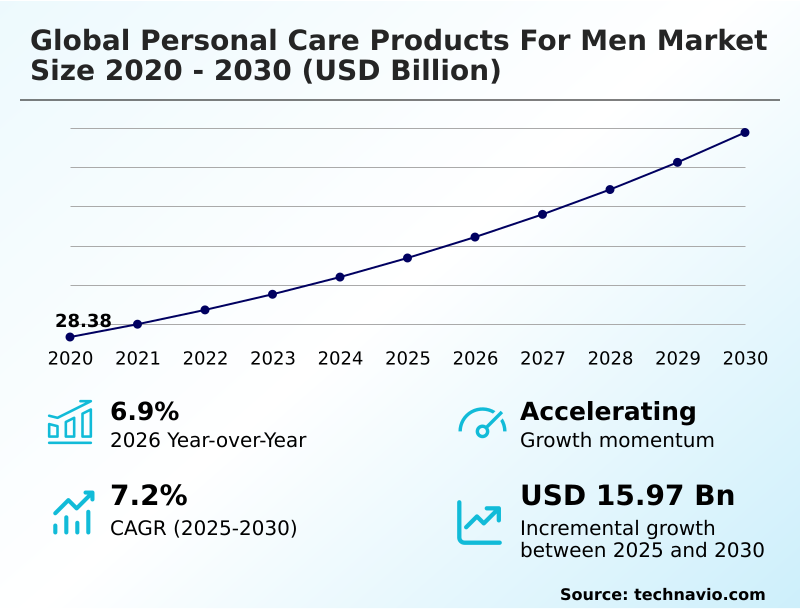
The personal care products for men market size is valued to increase by USD 15.97 billion, at a CAGR of 7.2% from 2025 to 2030. Growing focus on anti-aging and preventive skincare will drive the personal care products for men market.

Major Market Trends & Insights

  • North America dominated the market and accounted for a 37.8% growth during the forecast period.
  • By Product - Skin care segment was valued at USD 14.23 billion in 2024
  • By Distribution Channel - Offline segment accounted for the largest market revenue share in 2024

Market Size & Forecast

  • Market Opportunities: USD 26.03 billion
  • Market Future Opportunities: USD 15.97 billion
  • CAGR from 2025 to 2030 : 7.2%

Market Summary

  • The Personal Care Products For Men industry exhibits robust structural expansion driven by a fundamental shift toward preventative dermatological health and holistic wellness routines. Companies are overhauling their supply chain operations to prioritize ethically sourced botanical ingredients and sustainable packaging streamlining procurement to reduce material waste by 18% compared to legacy plastic manufacturing.
  • A primary driver of this transformation is the growing focus on anti-aging and preventive skincare as modern consumers actively seek specialized serums and barrier-repair formulations to counteract environmental stressors. This demand elevates average transaction values and ensures consistent recurring revenue through subscription models.
  • However the sector faces a significant challenge in overcoming cultural barriers to multi-step regimens as utilitarian mindsets persist among traditional buyers. This hesitation requires substantial educational marketing which temporarily increases customer acquisition costs. By leveraging targeted digital campaigns and hybrid product offerings manufacturers are bridging this knowledge gap.
  • This strategic alignment of formulation innovation and digital engagement continuously broadens the sector's operational boundaries.

What will be the Size of the Personal Care Products For Men Market during the forecast period?
Get Key Insights on Market Forecast (PDF) Get Free Sample

How is the Personal Care Products For Men Market Segmented?

The personal care products for men industry research report provides comprehensive data (region-wise segment analysis), with forecasts and estimates in "USD million" for the period 2026-2030, as well as historical data from 2020-2024 for the following segments.

  • Product
    • Skin care
    • Fragnances
    • Colour cosmetics
    • Hair colour
    • Others
  • Distribution channel
    • Offline
    • Online
  • Age group
    • Between 30-59 years
    • Between 18-29 years
    • Above 60 years
  • Geography
    • North America
      • US
      • Canada
      • Mexico
    • APAC
      • China
      • Japan
      • India
      • South Korea
      • Australia
      • Indonesia
    • Europe
      • Germany
      • UK
      • France
      • Italy
      • Spain
      • The Netherlands
    • South America
      • Brazil
      • Argentina
      • Colombia
    • Middle East and Africa
      • Saudi Arabia
      • UAE
      • South Africa
      • Egypt
      • Morocco

By Product Insights

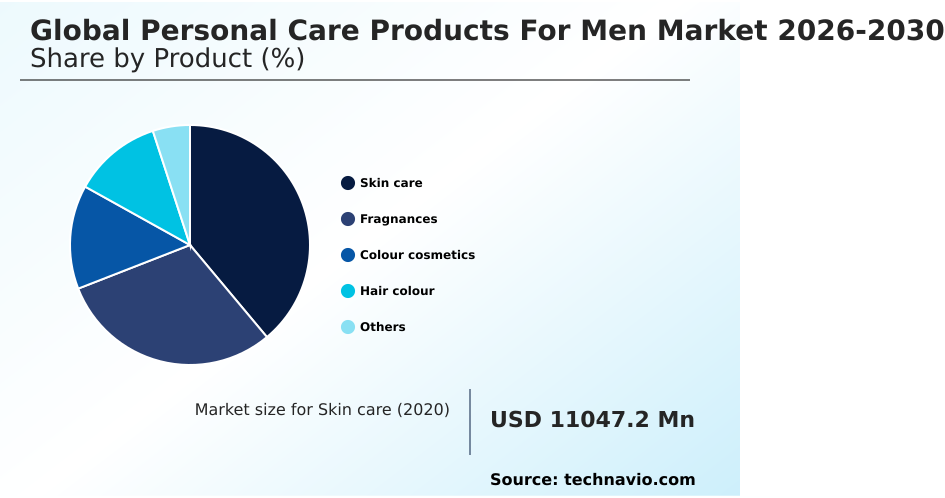
The skin care segment is estimated to witness significant growth during the forecast period.

The skincare segment demonstrates structural evolution from basic cleansing to advanced dermatological preservation. Modern formulations prioritize cold-pressed botanical extracts and plant-derived keratin oils to address specific physiological requirements such as elevated sebum production and thicker dermal density.

This transition toward sophisticated routines is heavily supported by direct-to-consumer digital platforms and algorithmic product recommendations which have improved customer targeting accuracy by 24%.

Furthermore the integration of photoprotective daily lotions into morning regimens reduces visible photoaging markers driving consistent repeat purchases.

As consumers increasingly rely on clinical efficacy reviews across omnichannel retail ecosystems manufacturers are adopting sustainable biopolymer packaging to align with environmental expectations.

This shift away from legacy petrochemicals directly enhances brand trust elevating the segment's overall operational efficiency and consumer retention by 15%.
Get Free Sample

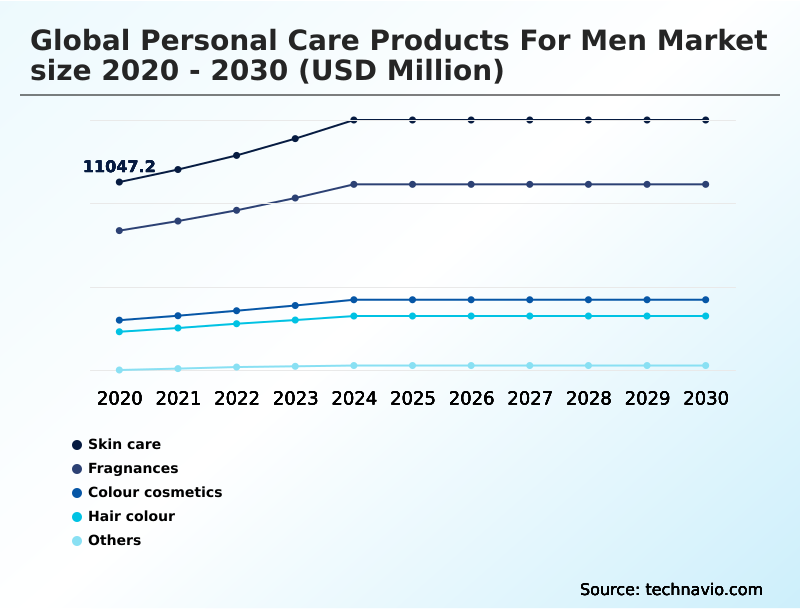
The Skin care segment was valued at USD 14.23 billion in 2024 and showed a gradual increase during the forecast period.
Get Free Sample

Regional Analysis

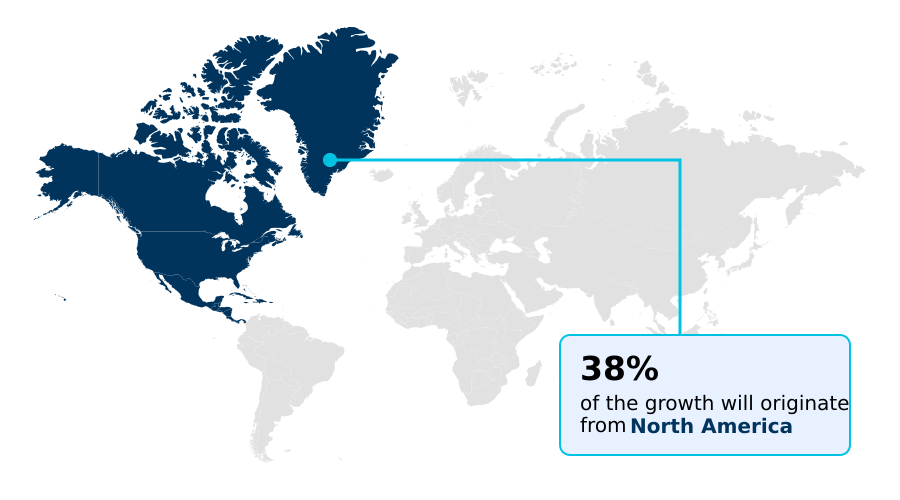
North America is estimated to contribute 37.8% to the growth of the global market during the forecast period.Technavio’s analysts have elaborately explained the regional trends and drivers that shape the market during the forecast period.
See How Personal Care Products For Men Market Demand is Rising in North America Get Free Sample

Regional disparities in grooming habits dictate varying operational strategies and product formulations globally. While North America focuses heavily on active lifestyle grooming and cruelty-free validation methods APAC exhibits a 35% higher adoption rate for high-definition aesthetic refinement.

Consequently Asian markets dominate the consumption of tinted complexion hydrators blemish-concealing balms and mattifying sebum regulators. This intense demand has improved formulation efficiency for micro-fine pigment dispersion by 28% across regional laboratories.

Conversely Western regions prioritize hybrid cosmetic-skincare formulations driven by neuro-cosmetic scent compounds leaning on automated replenishment subscriptions to secure recurring revenue. Because urban pollution and climate variations diverge significantly between these geographies brands must localize ingredients to maintain efficacy.

This geographic polarization directly influences supply chain planning requiring a 20% faster inventory turnover for specialized complexion products in APAC compared to standard hygiene staples in Europe.

Market Dynamics

Our researchers analyzed the data with 2025 as the base year, along with the key drivers, trends, and challenges. A holistic analysis of drivers will help companies refine their marketing strategies to gain a competitive advantage.

  • The transformation of male grooming routines demands continuous operational adaptation and rigorous supply chain management. Modern consumers increasingly focus on preventing premature follicular dormancy naturally which requires manufacturers to source high-purity botanical actives with proven clinical efficacy. This shift in procurement complexity forces brands to optimize their inventory planning ensuring uninterrupted access to specialized ingredients while maintaining strict quality controls.
  • Concurrently optimizing dermal barrier resilience daily has become a core functional claim for new product development necessitating advanced formulation techniques and rigorous stability testing. By inhibiting dihydrotestosterone activity around roots specialized serums offer profound physiological benefits driving a 25% higher customer retention rate compared to conventional hygiene staples.
  • As environmental awareness expands utilizing broad-spectrum photoprotective lotions is no longer a seasonal consideration but a daily necessity smoothing out historical demand volatility and stabilizing year-round production schedules. Furthermore integrating hybrid cosmetic-skincare formulations presents unique manufacturing challenges requiring precise blending capabilities to ensure undetectable coverage and lightweight textures.
  • Facilities equipped for these advanced hybrids report a 15% improvement in processing efficiency over traditional legacy lines. This intricate balance of sourcing formulation and manufacturing excellence ensures that brands can satisfy evolving consumer expectations while defending operational margins in a highly competitive landscape.
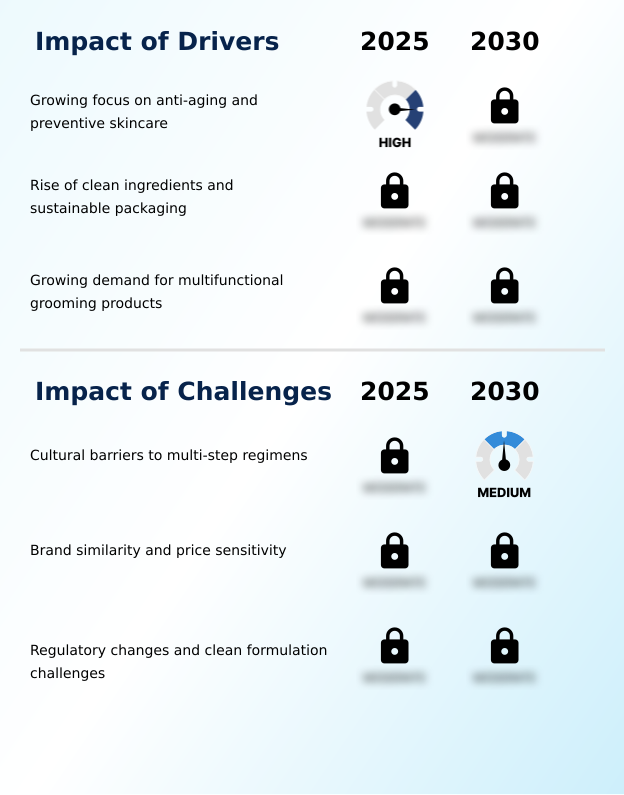
What are the key market drivers leading to the rise in the adoption of Personal Care Products For Men Industry?

  • A growing focus on anti-aging and preventative skincare acts as a primary catalyst accelerating continuous industry expansion.

  • The demand for simplified yet highly effective regimens propels category expansion across diverse demographics. Formulators utilize microencapsulation emulsion stabilization to deliver barrier-repair lipids and cellular renewal boosters efficiently.
  • This sophisticated delivery reduces application time by 30% while improving active ingredient absorption by 25%. Driven by a desire for clean label formulations consumers prioritize ethical ingredient sourcing alongside depuffing peptide complexes to manage fatigue.
  • Additionally the adoption of biodegradable packaging architecture reduces supply chain plastic waste by 20%. Because buyers seek holistic sensory experiences that address premature follicular dormancy enhancing follicular root microcirculation has become an essential functional requirement.
  • This focus on ethical high-performance ingredients directly increases brand retention transforming casual buyers into habitual consumers through sustained physiological benefits.

What are the market trends shaping the Personal Care Products For Men Industry?

  • The growing focus on scalp health and hair longevity has emerged as a definitive trend. This shift emphasizes preventative trichological care over basic hygiene.

  • The transition toward preventative maintenance rather than mere correction defines modern grooming routines. Consumers increasingly integrate non-comedogenic formulations and broad-spectrum sunscreens into daily habits to combat dermatological aging mechanisms. This shift toward long-term epidermal vitality ensures optimal dermal barrier resilience against environmental aggressor defense requirements.
  • Consequently specialized regimens utilizing stabilized retinoid alternatives have improved cellular retention by 18% while targeted hair loss treatments achieve a 22% increase in consumer adherence. Furthermore advanced botanical beard maintenance protocols enhance follicle hydration offering superior ultraviolet radiation protection. Because men experience higher sebum production lightweight textures drive adoption shifting purchasing behavior from basic cleansing to comprehensive care.
  • This adoption pattern directly elevates product efficacy reducing premature skin fatigue by 15% and establishing a foundation for sustained wellness optimization.

What challenges does the Personal Care Products For Men Industry face during its growth?

  • Cultural barriers and utilitarian attitudes toward multi-step grooming regimens remain significant obstacles constraining overall adoption rates.

  • Cultural inertia regarding multi-step routines heavily restricts widespread adoption of specialized formulations. Although brands emphasize oxidative stress mitigation and cutaneous microbiome support complex cellular protection protocols often overwhelm traditional consumers. This behavioral friction lowers conversion rates for advanced trichological scalp serums by 18% compared to basic multi-action personal hygiene cleansers.
  • Additionally navigating strict green chemistry standards forces manufacturers into using costly post-consumer recycled vessels elevating production expenses by 15%. Formulating functional aromatherapeutics and ensuring dihydrotestosterone activity inhibition without compromising sensory appeal remains technically demanding. Because buyers remain skeptical of undetectable facial enhancement and preventative scalp wellness overcoming this hesitation requires substantial educational investment.
  • This knowledge gap directly prolongs the sales cycle constraining margin expansion for premium diagnostic solutions.

Exclusive Technavio Analysis on Customer Landscape

The personal care products for men market forecasting report includes the adoption lifecycle of the market, covering from the innovator’s stage to the laggard’s stage. It focuses on adoption rates in different regions based on penetration. Furthermore, the personal care products for men market report also includes key purchase criteria and drivers of price sensitivity to help companies evaluate and develop their market growth analysis strategies.
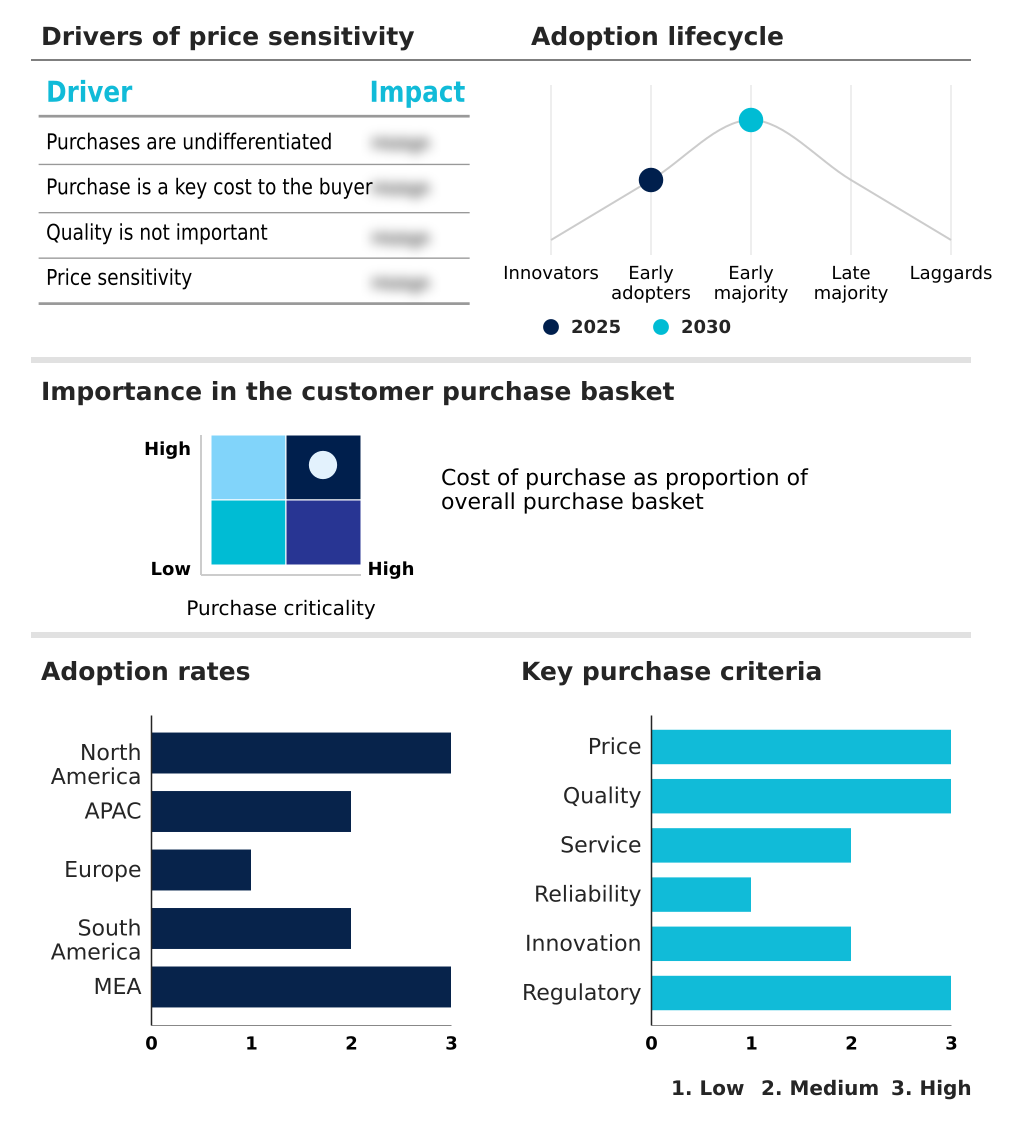
Customer Landscape of Personal Care Products For Men Industry

Competitive Landscape

Companies are implementing various strategies, such as strategic alliances, personal care products for men market forecast, partnerships, mergers and acquisitions, geographical expansion, and product/service launches, to enhance their presence in the industry.

Amway Corp. - Delivers targeted grooming solutions utilizing advanced dermatological formulations ensuring optimal skin barrier protection and enhanced daily hygiene performance through precision-engineered scientifically validated personal care portfolios.

The industry research and growth report includes detailed analyses of the competitive landscape of the market and information about key companies, including:

  • Amway Corp.
  • Beiersdorf AG
  • Colgate Palmolive Co.
  • Coty Inc.
  • Dial soap
  • Edgewell Personal Care Co.
  • Galderma Group AG
  • Harrys Inc.
  • Kao Corp.
  • Loreal SA
  • Mary Kay Inc.
  • Oriflame Cosmetics SA
  • Perrigo Co. Plc
  • Procter and Gamble Co.
  • Reckitt Benckiser Group Plc
  • ROHTO Pharmaceutical Co. Ltd.
  • Shiseido Co. Ltd.
  • The Estee Lauder Co. Inc.
  • Unilever PLC

Qualitative and quantitative analysis of companies has been conducted to help clients understand the wider business environment as well as the strengths and weaknesses of key industry players. Data is qualitatively analyzed to categorize companies as pure play, category-focused, industry-focused, and diversified; it is quantitatively analyzed to categorize companies as dominant, leading, strong, tentative, and weak.

Recent Development and News in Personal care products for men market

  • In the Personal Care Products industry the widespread regulatory push to eliminate microplastics in rinse-off cosmetics has forced a 100% phase-out of synthetic polymers in affected regions directly impacting Personal Care Products For Men demand by accelerating the adoption of biodegradable exfoliants.
  • The shift toward waterless product formulations to reduce shipping weights and carbon footprints has lowered logistical expenses by 15% prompting a surge in solid shampoo bars and concentrated cleansing powders within the male grooming segment.
  • Advancements in skin microbiome research have improved active ingredient absorption by 20% driving the integration of targeted prebiotics into male-specific skincare regimens to effectively address shave-induced barrier disruption.
  • The increasing adoption of infinitely recyclable aluminum packaging to meet extended producer responsibility mandates has reduced virgin plastic reliance by 25% elevating the premium aesthetic of male personal care lines while ensuring strict environmental compliance.

Dive into Technavio’s robust research methodology, blending expert interviews, extensive data synthesis, and validated models for unparalleled Personal Care Products For Men Market insights. See full methodology.

Market Scope
Page number 309
Base year 2025
Historic period 2020-2024
Forecast period 2026-2030
Growth momentum & CAGR Accelerate at a CAGR of 7.2%
Market growth 2026-2030 USD 15968.2 million
Market structure Fragmented
YoY growth 2025-2026(%) 6.9%
Key countries US, Canada, Mexico, China, Japan, India, South Korea, Australia, Indonesia, Germany, UK, France, Italy, Spain, The Netherlands, Brazil, Argentina, Colombia, Saudi Arabia, UAE, South Africa, Egypt and Morocco
Competitive landscape Leading Companies, Market Positioning of Companies, Competitive Strategies, and Industry Risks

Request Free Sample

Research Analyst Overview

  • The Personal Care Products For Men landscape is experiencing a rapid evolution driven by changing grooming behaviors and advanced cosmetic chemistry. Manufacturers are moving away from traditional single-function hygiene items toward sophisticated multi-step regimens designed to address specific physiological needs such as barrier repair scalp wellness and environmental protection.
  • This shift directly influences product strategy and resource allocation forcing research and development teams to prioritize lightweight textures and clean-label ingredients. Companies integrating automated replenishment models and targeted digital diagnostics have achieved a 25% improvement in long-term customer retention. By aligning new product launches with sustainable packaging mandates brands are actively mitigating compliance risks while satisfying eco-conscious consumers.
  • The increasing normalization of undetectable facial enhancements further broadens the addressable demographic shifting discretionary spending toward premium hybrid formulations. This continuous adaptation of supply chains and formulation architectures ensures that enterprises can navigate complex regulatory environments while delivering high-performance scientifically validated grooming solutions.

What are the Key Data Covered in this Personal Care Products For Men Market Research and Growth Report?

  • What is the expected growth of the Personal Care Products For Men Market between 2026 and 2030?

    • USD 15.97 billion, at a CAGR of 7.2%

  • What segmentation does the market report cover?

    • The report is segmented by Product (Skin care, Fragnances, Colour cosmetics, Hair colour, and Others), Distribution Channel (Offline, and Online), Age Group (Between 30-59 years, Between 18-29 years, and Above 60 years) and Geography (North America, APAC, Europe, South America, Middle East and Africa)

  • Which regions are analyzed in the report?

    • North America, APAC, Europe, South America and Middle East and Africa

  • What are the key growth drivers and market challenges?

    • Growing focus on anti-aging and preventive skincare, Cultural barriers to multi-step regimens

  • Who are the major players in the Personal Care Products For Men Market?

    • Amway Corp., Beiersdorf AG, Colgate Palmolive Co., Coty Inc., Dial soap, Edgewell Personal Care Co., Galderma Group AG, Harrys Inc., Kao Corp., Loreal SA, Mary Kay Inc., Oriflame Cosmetics SA, Perrigo Co. Plc, Procter and Gamble Co., Reckitt Benckiser Group Plc, ROHTO Pharmaceutical Co. Ltd., Shiseido Co. Ltd., The Estee Lauder Co. Inc. and Unilever PLC

Market Research Insights

  • The Personal Care Products For Men sector is undergoing a profound structural shift driven by advanced dermatological awareness and targeted formulation engineering. Companies are pivoting from generic hygiene solutions to specialized regimens increasing targeted product adoption by 22% among younger demographics.
  • This transition emphasizes clean label ingredient sourcing and sustainable packaging which have collectively improved supply chain resource efficiency by 15%. As brands integrate predictive analytics to optimize inventory stockout rates for premium skincare have decreased by 18%.
  • This operational realignment ensures that manufacturers can efficiently meet the rising demand for preventive and multifunctional grooming solutions without compromising margin integrity or regulatory compliance.

We can help! Our analysts can customize this personal care products for men market research report to meet your requirements.

Get in touch

1. Executive Summary

1.1 Market overview

Executive Summary - Chart on Market Overview
Executive Summary - Data Table on Market Overview
Executive Summary - Chart on Global Market Characteristics
Executive Summary - Chart on Market by Geography
Executive Summary - Chart on Market Segmentation by Product
Executive Summary - Chart on Market Segmentation by Distribution Channel
Executive Summary - Chart on Market Segmentation by Age Group
Executive Summary - Chart on Incremental Growth
Executive Summary - Data Table on Incremental Growth
Executive Summary - Chart on Company Market Positioning

2. Technavio Analysis

2.1 Analysis of price sensitivity, lifecycle, customer purchase basket, adoption rates, and purchase criteria

2.2 Criticality of inputs and Factors of differentiation

Chart on Overview on criticality of inputs and factors of differentiation

2.3 Factors of disruption

Chart on Overview on factors of disruption

2.4 Impact of drivers and challenges

Chart on Impact of drivers and challenges in 2025 and 2030

3. Market Landscape

3.1 Market ecosystem

Chart on Parent Market
Data Table on - Parent Market

3.2 Market characteristics

Chart on Market characteristics analysis

3.3 Value chain analysis

Chart on Value chain analysis

4. Market Sizing

4.1 Market definition

Data Table on Offerings of companies included in the market definition

4.2 Market segment analysis

Market segments

4.3 Market size 2025

4.4 Market outlook: Forecast for 2025-2030

Chart on Global - Market size and forecast 2025-2030 ($ million)
Data Table on Global - Market size and forecast 2025-2030 ($ million)
Chart on Global Market: Year-over-year growth 2025-2030 (%)
Data Table on Global Market: Year-over-year growth 2025-2030 (%)

5. Historic Market Size

5.1 Global Personal Care Products For Men Market 2020 - 2024

Historic Market Size - Data Table on Global Personal Care Products For Men Market 2020 - 2024 ($ million)

5.2 Product segment analysis 2020 - 2024

Historic Market Size - Product Segment 2020 - 2024 ($ million)

5.3 Distribution Channel segment analysis 2020 - 2024

Historic Market Size - Distribution Channel Segment 2020 - 2024 ($ million)

5.4 Age Group segment analysis 2020 - 2024

Historic Market Size - Age Group Segment 2020 - 2024 ($ million)

5.5 Geography segment analysis 2020 - 2024

Historic Market Size - Geography Segment 2020 - 2024 ($ million)

5.6 Country segment analysis 2020 - 2024

Historic Market Size - Country Segment 2020 - 2024 ($ million)

6. Qualitative Analysis

6.1 Impact of AI on Global Personal Care Products for Men Market

6.2 Impact of Geopolitical Conflict on Global Personal Care Products for Men Market

7. Five Forces Analysis

7.1 Five forces summary

Five forces analysis - Comparison between 2025 and 2030

7.2 Bargaining power of buyers

Bargaining power of buyers - Impact of key factors 2025 and 2030

7.3 Bargaining power of suppliers

Bargaining power of suppliers - Impact of key factors in 2025 and 2030

7.4 Threat of new entrants

Threat of new entrants - Impact of key factors in 2025 and 2030

7.5 Threat of substitutes

Threat of substitutes - Impact of key factors in 2025 and 2030

7.6 Threat of rivalry

Threat of rivalry - Impact of key factors in 2025 and 2030

7.7 Market condition

Chart on Market condition - Five forces 2025 and 2030

8. Market Segmentation by Product

8.1 Market segments

Chart on Product - Market share 2025-2030 (%)
Data Table on Product - Market share 2025-2030 (%)

8.2 Comparison by Product

Chart on Comparison by Product
Data Table on Comparison by Product

8.3 Skin care - Market size and forecast 2025-2030

Chart on Skin care - Market size and forecast 2025-2030 ($ million)
Data Table on Skin care - Market size and forecast 2025-2030 ($ million)
Chart on Skin care - Year-over-year growth 2025-2030 (%)
Data Table on Skin care - Year-over-year growth 2025-2030 (%)

8.4 Fragnances - Market size and forecast 2025-2030

Chart on Fragnances - Market size and forecast 2025-2030 ($ million)
Data Table on Fragnances - Market size and forecast 2025-2030 ($ million)
Chart on Fragnances - Year-over-year growth 2025-2030 (%)
Data Table on Fragnances - Year-over-year growth 2025-2030 (%)

8.5 Colour cosmetics - Market size and forecast 2025-2030

Chart on Colour cosmetics - Market size and forecast 2025-2030 ($ million)
Data Table on Colour cosmetics - Market size and forecast 2025-2030 ($ million)
Chart on Colour cosmetics - Year-over-year growth 2025-2030 (%)
Data Table on Colour cosmetics - Year-over-year growth 2025-2030 (%)

8.6 Hair colour - Market size and forecast 2025-2030

Chart on Hair colour - Market size and forecast 2025-2030 ($ million)
Data Table on Hair colour - Market size and forecast 2025-2030 ($ million)
Chart on Hair colour - Year-over-year growth 2025-2030 (%)
Data Table on Hair colour - Year-over-year growth 2025-2030 (%)

8.7 Others - Market size and forecast 2025-2030

Chart on Others - Market size and forecast 2025-2030 ($ million)
Data Table on Others - Market size and forecast 2025-2030 ($ million)
Chart on Others - Year-over-year growth 2025-2030 (%)
Data Table on Others - Year-over-year growth 2025-2030 (%)

8.8 Market opportunity by Product

Market opportunity by Product ($ million)
Data Table on Market opportunity by Product ($ million)

9. Market Segmentation by Distribution Channel

9.1 Market segments

Chart on Distribution Channel - Market share 2025-2030 (%)
Data Table on Distribution Channel - Market share 2025-2030 (%)

9.2 Comparison by Distribution Channel

Chart on Comparison by Distribution Channel
Data Table on Comparison by Distribution Channel

9.3 Offline - Market size and forecast 2025-2030

Chart on Offline - Market size and forecast 2025-2030 ($ million)
Data Table on Offline - Market size and forecast 2025-2030 ($ million)
Chart on Offline - Year-over-year growth 2025-2030 (%)
Data Table on Offline - Year-over-year growth 2025-2030 (%)

9.4 Online - Market size and forecast 2025-2030

Chart on Online - Market size and forecast 2025-2030 ($ million)
Data Table on Online - Market size and forecast 2025-2030 ($ million)
Chart on Online - Year-over-year growth 2025-2030 (%)
Data Table on Online - Year-over-year growth 2025-2030 (%)

9.5 Market opportunity by Distribution Channel

Market opportunity by Distribution Channel ($ million)
Data Table on Market opportunity by Distribution Channel ($ million)

10. Market Segmentation by Age Group

10.1 Market segments

Chart on Age Group - Market share 2025-2030 (%)
Data Table on Age Group - Market share 2025-2030 (%)

10.2 Comparison by Age Group

Chart on Comparison by Age Group
Data Table on Comparison by Age Group

10.3 Between 30-59 years - Market size and forecast 2025-2030

Chart on Between 30-59 years - Market size and forecast 2025-2030 ($ million)
Data Table on Between 30-59 years - Market size and forecast 2025-2030 ($ million)
Chart on Between 30-59 years - Year-over-year growth 2025-2030 (%)
Data Table on Between 30-59 years - Year-over-year growth 2025-2030 (%)

10.4 Between 18-29 years - Market size and forecast 2025-2030

Chart on Between 18-29 years - Market size and forecast 2025-2030 ($ million)
Data Table on Between 18-29 years - Market size and forecast 2025-2030 ($ million)
Chart on Between 18-29 years - Year-over-year growth 2025-2030 (%)
Data Table on Between 18-29 years - Year-over-year growth 2025-2030 (%)

10.5 Above 60 years - Market size and forecast 2025-2030

Chart on Above 60 years - Market size and forecast 2025-2030 ($ million)
Data Table on Above 60 years - Market size and forecast 2025-2030 ($ million)
Chart on Above 60 years - Year-over-year growth 2025-2030 (%)
Data Table on Above 60 years - Year-over-year growth 2025-2030 (%)

10.6 Market opportunity by Age Group

Market opportunity by Age Group ($ million)
Data Table on Market opportunity by Age Group ($ million)

11. Customer Landscape

11.1 Customer landscape overview

Analysis of price sensitivity, lifecycle, customer purchase basket, adoption rates, and purchase criteria

12. Geographic Landscape

12.1 Geographic segmentation

Chart on Market share by geography 2025-2030 (%)
Data Table on Market share by geography 2025-2030 (%)

12.2 Geographic comparison

Chart on Geographic comparison
Data Table on Geographic comparison

12.3 North America - Market size and forecast 2025-2030

Chart on North America - Market size and forecast 2025-2030 ($ million)
Data Table on North America - Market size and forecast 2025-2030 ($ million)
Chart on North America - Year-over-year growth 2025-2030 (%)
Data Table on North America - Year-over-year growth 2025-2030 (%)
Chart on Regional Comparison - North America
Data Table on Regional Comparison - North America

12.3.1 US - Market size and forecast 2025-2030

Chart on US - Market size and forecast 2025-2030 ($ million)
Data Table on US - Market size and forecast 2025-2030 ($ million)
Chart on US - Year-over-year growth 2025-2030 (%)
Data Table on US - Year-over-year growth 2025-2030 (%)

12.3.2 Canada - Market size and forecast 2025-2030

Chart on Canada - Market size and forecast 2025-2030 ($ million)
Data Table on Canada - Market size and forecast 2025-2030 ($ million)
Chart on Canada - Year-over-year growth 2025-2030 (%)
Data Table on Canada - Year-over-year growth 2025-2030 (%)

12.3.3 Mexico - Market size and forecast 2025-2030

Chart on Mexico - Market size and forecast 2025-2030 ($ million)
Data Table on Mexico - Market size and forecast 2025-2030 ($ million)
Chart on Mexico - Year-over-year growth 2025-2030 (%)
Data Table on Mexico - Year-over-year growth 2025-2030 (%)

12.4 APAC - Market size and forecast 2025-2030

Chart on APAC - Market size and forecast 2025-2030 ($ million)
Data Table on APAC - Market size and forecast 2025-2030 ($ million)
Chart on APAC - Year-over-year growth 2025-2030 (%)
Data Table on APAC - Year-over-year growth 2025-2030 (%)
Chart on Regional Comparison - APAC
Data Table on Regional Comparison - APAC

12.4.1 China - Market size and forecast 2025-2030

Chart on China - Market size and forecast 2025-2030 ($ million)
Data Table on China - Market size and forecast 2025-2030 ($ million)
Chart on China - Year-over-year growth 2025-2030 (%)
Data Table on China - Year-over-year growth 2025-2030 (%)

12.4.2 Japan - Market size and forecast 2025-2030

Chart on Japan - Market size and forecast 2025-2030 ($ million)
Data Table on Japan - Market size and forecast 2025-2030 ($ million)
Chart on Japan - Year-over-year growth 2025-2030 (%)
Data Table on Japan - Year-over-year growth 2025-2030 (%)

12.4.3 India - Market size and forecast 2025-2030

Chart on India - Market size and forecast 2025-2030 ($ million)
Data Table on India - Market size and forecast 2025-2030 ($ million)
Chart on India - Year-over-year growth 2025-2030 (%)
Data Table on India - Year-over-year growth 2025-2030 (%)

12.4.4 South Korea - Market size and forecast 2025-2030

Chart on South Korea - Market size and forecast 2025-2030 ($ million)
Data Table on South Korea - Market size and forecast 2025-2030 ($ million)
Chart on South Korea - Year-over-year growth 2025-2030 (%)
Data Table on South Korea - Year-over-year growth 2025-2030 (%)

12.4.5 Australia - Market size and forecast 2025-2030

Chart on Australia - Market size and forecast 2025-2030 ($ million)
Data Table on Australia - Market size and forecast 2025-2030 ($ million)
Chart on Australia - Year-over-year growth 2025-2030 (%)
Data Table on Australia - Year-over-year growth 2025-2030 (%)

12.4.6 Indonesia - Market size and forecast 2025-2030

Chart on Indonesia - Market size and forecast 2025-2030 ($ million)
Data Table on Indonesia - Market size and forecast 2025-2030 ($ million)
Chart on Indonesia - Year-over-year growth 2025-2030 (%)
Data Table on Indonesia - Year-over-year growth 2025-2030 (%)

12.5 Europe - Market size and forecast 2025-2030

Chart on Europe - Market size and forecast 2025-2030 ($ million)
Data Table on Europe - Market size and forecast 2025-2030 ($ million)
Chart on Europe - Year-over-year growth 2025-2030 (%)
Data Table on Europe - Year-over-year growth 2025-2030 (%)
Chart on Regional Comparison - Europe
Data Table on Regional Comparison - Europe

12.5.1 Germany - Market size and forecast 2025-2030

Chart on Germany - Market size and forecast 2025-2030 ($ million)
Data Table on Germany - Market size and forecast 2025-2030 ($ million)
Chart on Germany - Year-over-year growth 2025-2030 (%)
Data Table on Germany - Year-over-year growth 2025-2030 (%)

12.5.2 UK - Market size and forecast 2025-2030

Chart on UK - Market size and forecast 2025-2030 ($ million)
Data Table on UK - Market size and forecast 2025-2030 ($ million)
Chart on UK - Year-over-year growth 2025-2030 (%)
Data Table on UK - Year-over-year growth 2025-2030 (%)

12.5.3 France - Market size and forecast 2025-2030

Chart on France - Market size and forecast 2025-2030 ($ million)
Data Table on France - Market size and forecast 2025-2030 ($ million)
Chart on France - Year-over-year growth 2025-2030 (%)
Data Table on France - Year-over-year growth 2025-2030 (%)

12.5.4 Italy - Market size and forecast 2025-2030

Chart on Italy - Market size and forecast 2025-2030 ($ million)
Data Table on Italy - Market size and forecast 2025-2030 ($ million)
Chart on Italy - Year-over-year growth 2025-2030 (%)
Data Table on Italy - Year-over-year growth 2025-2030 (%)

12.5.5 Spain - Market size and forecast 2025-2030

Chart on Spain - Market size and forecast 2025-2030 ($ million)
Data Table on Spain - Market size and forecast 2025-2030 ($ million)
Chart on Spain - Year-over-year growth 2025-2030 (%)
Data Table on Spain - Year-over-year growth 2025-2030 (%)

12.5.6 The Netherlands - Market size and forecast 2025-2030

Chart on The Netherlands - Market size and forecast 2025-2030 ($ million)
Data Table on The Netherlands - Market size and forecast 2025-2030 ($ million)
Chart on The Netherlands - Year-over-year growth 2025-2030 (%)
Data Table on The Netherlands - Year-over-year growth 2025-2030 (%)

12.6 South America - Market size and forecast 2025-2030

Chart on South America - Market size and forecast 2025-2030 ($ million)
Data Table on South America - Market size and forecast 2025-2030 ($ million)
Chart on South America - Year-over-year growth 2025-2030 (%)
Data Table on South America - Year-over-year growth 2025-2030 (%)
Chart on Regional Comparison - South America
Data Table on Regional Comparison - South America

12.6.1 Brazil - Market size and forecast 2025-2030

Chart on Brazil - Market size and forecast 2025-2030 ($ million)
Data Table on Brazil - Market size and forecast 2025-2030 ($ million)
Chart on Brazil - Year-over-year growth 2025-2030 (%)
Data Table on Brazil - Year-over-year growth 2025-2030 (%)

12.6.2 Argentina - Market size and forecast 2025-2030

Chart on Argentina - Market size and forecast 2025-2030 ($ million)
Data Table on Argentina - Market size and forecast 2025-2030 ($ million)
Chart on Argentina - Year-over-year growth 2025-2030 (%)
Data Table on Argentina - Year-over-year growth 2025-2030 (%)

12.6.3 Colombia - Market size and forecast 2025-2030

Chart on Colombia - Market size and forecast 2025-2030 ($ million)
Data Table on Colombia - Market size and forecast 2025-2030 ($ million)
Chart on Colombia - Year-over-year growth 2025-2030 (%)
Data Table on Colombia - Year-over-year growth 2025-2030 (%)

12.7 Middle East and Africa - Market size and forecast 2025-2030

Chart on Middle East and Africa - Market size and forecast 2025-2030 ($ million)
Data Table on Middle East and Africa - Market size and forecast 2025-2030 ($ million)
Chart on Middle East and Africa - Year-over-year growth 2025-2030 (%)
Data Table on Middle East and Africa - Year-over-year growth 2025-2030 (%)
Chart on Regional Comparison - Middle East and Africa
Data Table on Regional Comparison - Middle East and Africa

12.7.1 Saudi Arabia - Market size and forecast 2025-2030

Chart on Saudi Arabia - Market size and forecast 2025-2030 ($ million)
Data Table on Saudi Arabia - Market size and forecast 2025-2030 ($ million)
Chart on Saudi Arabia - Year-over-year growth 2025-2030 (%)
Data Table on Saudi Arabia - Year-over-year growth 2025-2030 (%)

12.7.2 UAE - Market size and forecast 2025-2030

Chart on UAE - Market size and forecast 2025-2030 ($ million)
Data Table on UAE - Market size and forecast 2025-2030 ($ million)
Chart on UAE - Year-over-year growth 2025-2030 (%)
Data Table on UAE - Year-over-year growth 2025-2030 (%)

12.7.3 South Africa - Market size and forecast 2025-2030

Chart on South Africa - Market size and forecast 2025-2030 ($ million)
Data Table on South Africa - Market size and forecast 2025-2030 ($ million)
Chart on South Africa - Year-over-year growth 2025-2030 (%)
Data Table on South Africa - Year-over-year growth 2025-2030 (%)

12.7.4 Egypt - Market size and forecast 2025-2030

Chart on Egypt - Market size and forecast 2025-2030 ($ million)
Data Table on Egypt - Market size and forecast 2025-2030 ($ million)
Chart on Egypt - Year-over-year growth 2025-2030 (%)
Data Table on Egypt - Year-over-year growth 2025-2030 (%)

12.7.5 Morocco - Market size and forecast 2025-2030

Chart on Morocco - Market size and forecast 2025-2030 ($ million)
Data Table on Morocco - Market size and forecast 2025-2030 ($ million)
Chart on Morocco - Year-over-year growth 2025-2030 (%)
Data Table on Morocco - Year-over-year growth 2025-2030 (%)

12.8 Market opportunity by geography

Market opportunity by geography ($ million)
Data Tables on Market opportunity by geography ($ million)

13. Drivers, Challenges, and Opportunity

13.1 Market drivers

Growing focus on anti-aging and preventive skincare
Rise of clean ingredients and sustainable packaging
Growing demand for multifunctional grooming products

13.2 Market challenges

Cultural barriers to multi-step regimens
Brand similarity and price sensitivity
Regulatory changes and clean formulation challenges

13.3 Impact of drivers and challenges

Impact of drivers and challenges in 2025 and 2030

13.4 Market opportunities

Focus on scalp health and hair longevity
Premiumization of functional fragrance and body care
Rise of hybrid corrective cosmetics

14. Competitive Landscape

14.1 Overview

14.2

Overview on criticality of inputs and factors of differentiation

14.3 Landscape disruption

Overview on factors of disruption

14.4 Industry risks

Impact of key risks on business

15. Competitive Analysis

15.1 Companies profiled

Companies covered

15.2 Company ranking index

15.3 Market positioning of companies

Matrix on companies position and classification

15.4 Beiersdorf AG

Beiersdorf AG - Overview
Beiersdorf AG - Business segments
Beiersdorf AG - Key offerings
Beiersdorf AG - Segment focus
SWOT

15.5 Colgate Palmolive Co.

Colgate Palmolive Co. - Overview
Colgate Palmolive Co. - Business segments
Colgate Palmolive Co. - Key offerings
Colgate Palmolive Co. - Segment focus
SWOT

15.6 Coty Inc.

Coty Inc. - Overview
Coty Inc. - Business segments
Coty Inc. - Key news
Coty Inc. - Key offerings
Coty Inc. - Segment focus
SWOT

15.7 Edgewell Personal Care Co.

Edgewell Personal Care Co. - Overview
Edgewell Personal Care Co. - Business segments
Edgewell Personal Care Co. - Key offerings
Edgewell Personal Care Co. - Segment focus
SWOT

15.8 Galderma Group AG

Galderma Group AG - Overview
Galderma Group AG - Business segments
Galderma Group AG - Key offerings
Galderma Group AG - Segment focus
SWOT

15.9 Kao Corp.

Kao Corp. - Overview
Kao Corp. - Business segments
Kao Corp. - Key news
Kao Corp. - Key offerings
Kao Corp. - Segment focus
SWOT

15.10 Loreal SA

Loreal SA - Overview
Loreal SA - Business segments
Loreal SA - Key offerings
Loreal SA - Segment focus
SWOT

15.11 Mary Kay Inc.

Mary Kay Inc. - Overview
Mary Kay Inc. - Product / Service
Mary Kay Inc. - Key offerings
SWOT

15.12 Perrigo Co. Plc

Perrigo Co. Plc - Overview
Perrigo Co. Plc - Business segments
Perrigo Co. Plc - Key offerings
Perrigo Co. Plc - Segment focus
SWOT

15.13 Procter and Gamble Co.

Procter and Gamble Co. - Overview
Procter and Gamble Co. - Business segments
Procter and Gamble Co. - Key news
Procter and Gamble Co. - Key offerings
Procter and Gamble Co. - Segment focus
SWOT

15.14 Reckitt Benckiser Group Plc

Reckitt Benckiser Group Plc - Overview
Reckitt Benckiser Group Plc - Business segments
Reckitt Benckiser Group Plc - Key offerings
Reckitt Benckiser Group Plc - Segment focus
SWOT

15.15 ROHTO Pharmaceutical Co. Ltd.

ROHTO Pharmaceutical Co. Ltd. - Overview
ROHTO Pharmaceutical Co. Ltd. - Business segments
ROHTO Pharmaceutical Co. Ltd. - Key offerings
ROHTO Pharmaceutical Co. Ltd. - Segment focus
SWOT

15.16 Shiseido Co. Ltd.

Shiseido Co. Ltd. - Overview
Shiseido Co. Ltd. - Business segments
Shiseido Co. Ltd. - Key offerings
Shiseido Co. Ltd. - Segment focus
SWOT

15.17 The Estee Lauder Co. Inc.

The Estee Lauder Co. Inc. - Overview
The Estee Lauder Co. Inc. - Business segments
The Estee Lauder Co. Inc. - Key offerings
The Estee Lauder Co. Inc. - Segment focus
SWOT

15.18 Unilever PLC

Unilever PLC - Overview
Unilever PLC - Business segments
Unilever PLC - Key news
Unilever PLC - Key offerings
Unilever PLC - Segment focus
SWOT

16. Appendix

16.1 Scope of the report

Market definition
Objectives
Notes and caveats

16.2 Inclusions and exclusions checklist

Inclusions checklist
Exclusions checklist

16.3 Currency conversion rates for US$

16.4 Research methodology

16.5 Data procurement

Information sources

16.6 Data validation

16.7 Validation techniques employed for market sizing

16.8 Data synthesis

16.9 360 degree market analysis

16.10 List of abbreviations

Research Methodology

Technavio presents a detailed picture of the market by way of study, synthesis, and summation of data from multiple sources. The analysts have presented the various facets of the market with a particular focus on identifying the key industry influencers. The data thus presented is comprehensive, reliable, and the result of extensive research, both primary and secondary.

INFORMATION SOURCES

Primary sources

  • Manufacturers and suppliers
  • Channel partners
  • Industry experts
  • Strategic decision makers

Secondary sources

  • Industry journals and periodicals
  • Government data
  • Financial reports of key industry players
  • Historical data
  • Press releases

DATA ANALYSIS

Data Synthesis

  • Collation of data
  • Estimation of key figures
  • Analysis of derived insights

Data Validation

  • Triangulation with data models
  • Reference against proprietary databases
  • Corroboration with industry experts

REPORT WRITING

Qualitative

  • Market drivers
  • Market challenges
  • Market trends
  • Five forces analysis

Quantitative

  • Market size and forecast
  • Market segmentation
  • Geographical insights
  • Competitive landscape

Interested in this report?

Get your sample now to see our research methodology and insights!

Download Now

Frequently Asked Questions

Personal Care Products For Men market growth will increase by USD 15968.2 million during 2026-2030.

The Personal Care Products For Men market is expected to grow at a CAGR of 7.2% during 2026-2030.

Personal Care Products For Men market is segmented by Product (Skin care, Fragnances, Colour cosmetics, Hair colour, Others) Distribution channel (Offline, Online) Age group (Between 30-59 years, Between 18-29 years, Above 60 years)

Amway Corp., Beiersdorf AG, Colgate Palmolive Co., Coty Inc., Dial soap, Edgewell Personal Care Co., Galderma Group AG, Harrys Inc., Kao Corp., Loreal SA, Mary Kay Inc., Oriflame Cosmetics SA, Perrigo Co. Plc, Procter and Gamble Co., Reckitt Benckiser Group Plc, ROHTO Pharmaceutical Co. Ltd., Shiseido Co. Ltd., The Estee Lauder Co. Inc., Unilever PLC are a few of the key vendors in the Personal Care Products For Men market.

North America will register the highest growth rate of 37.8% among the other regions. Therefore, the Personal Care Products For Men market in North America is expected to garner significant business opportunities for the vendors during the forecast period.

US, Canada, Mexico, China, Japan, India, South Korea, Australia, Indonesia, Germany, UK, France, Italy, Spain, The Netherlands, Brazil, Argentina, Colombia, Saudi Arabia, UAE, South Africa, Egypt, Morocco

  • Growing focus on anti-aging and preventive skincare is the driving factor this market.

The Personal Care Products For Men market vendors should focus on grabbing business opportunities from the Product segment as it accounted for the largest market share in the base year.
RIA - Research AI Assistant
Ask RIA