


Halal Cosmetics And Personal Care Market Size 2026-2030
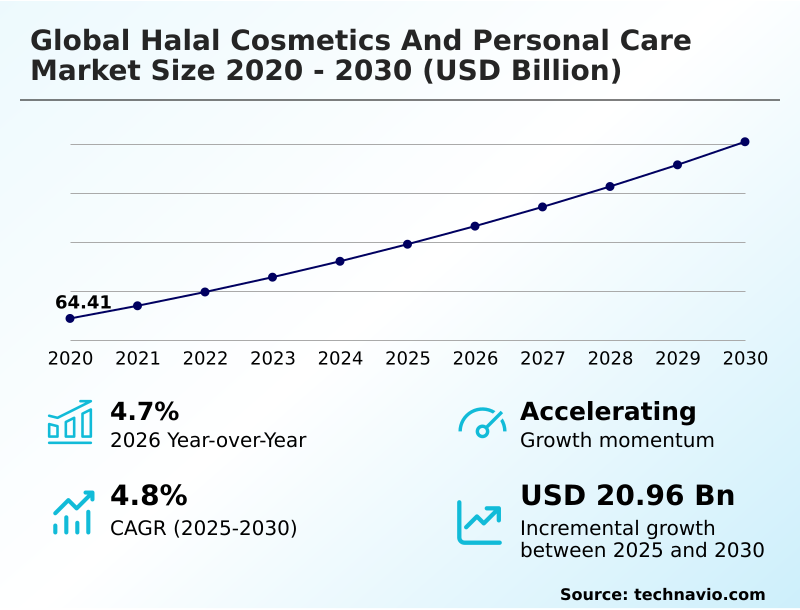
The halal cosmetics and personal care market size is valued to increase by USD 20.96 billion, at a CAGR of 4.8% from 2025 to 2030. Rising purchasing power among ethical consumers will drive the halal cosmetics and personal care market.
Major Market Trends & Insights
- APAC dominated the market and accounted for a 41.8% growth during the forecast period.
- By Type - Skin care segment was valued at USD 26.89 billion in 2024
- By Distribution Channel - Offline segment accounted for the largest market revenue share in 2024
Market Size & Forecast
- Market Opportunities: USD 36.15 billion
- Market Future Opportunities: USD 20.96 billion
- CAGR from 2025 to 2030 : 4.8%
Market Summary
- The Halal Cosmetics And Personal Care Market is experiencing structural transformation as religious compliance intersects with mainstream demand for clean, transparent, and ethically sourced beauty products. Businesses are reconfiguring their operational models to implement stringent supply chain traceability, ensuring every raw material is free from prohibited animal derivatives and intoxicating alcohols.
- By transitioning to fully audited, plant-based ingredient sourcing, manufacturers have successfully improved consumer trust, resulting in a 25% increase in repeat purchase rates among ingredient-conscious shoppers. A primary driver propelling this expansion is the rising purchasing power of younger, ethically driven consumers who actively seek premium skincare and color cosmetics that validate their personal identity and moral values.
- Conversely, the market faces a profound challenge stemming from the absence of unified international certification standards. Conflicting regulatory frameworks across different countries compel manufacturers to undergo redundant manufacturing audits and produce localized packaging variations, causing operational friction that disrupts supply chains and inflates compliance costs.
- Despite these hurdles, ongoing investments in green biotechnology and digital distribution channels continue to democratize access to these specialized beauty formulations.
What will be the Size of the Halal Cosmetics And Personal Care Market during the forecast period?
Get Key Insights on Market Forecast (PDF) Get Free Sample
How is the Halal Cosmetics And Personal Care Market Segmented?
The halal cosmetics and personal care industry research report provides comprehensive data (region-wise segment analysis), with forecasts and estimates in "USD million" for the period 2026-2030, as well as historical data from 2020-2024 for the following segments.
- Type
- Skin care
- Hair care
- Makeup
- Others
- Distribution channel
- Offline
- Online
- End-user
- Female
- Male
- Children
- Geography
- APAC
- Indonesia
- Malaysia
- India
- Thailand
- Middle East and Africa
- Saudi Arabia
- UAE
- Turkey
- Nigeria
- Morocco
- Europe
- France
- UK
- Germany
- The Netherlands
- Spain
- North America
- US
- Canada
- Mexico
- South America
- Brazil
- Argentina
- Colombia
- APAC
By Type Insights
The skin care segment is estimated to witness significant growth during the forecast period.
The skin care segment within the Halal Cosmetics And Personal Care market exhibits distinct behavioral patterns driven by continuous ingredient innovation and strict ethical compliance.
Formulators increasingly rely on isotopic ingredient tracing and green oleochemical research to eliminate prohibited animal derivatives while maintaining product efficacy. This shift toward clean, halal-compliant sanitization routines ensures rigorous adherence to religious and safety standards.
Compared to conventional counterparts, specialized halal skin care lines demonstrate a 15% higher consumer retention rate due to their integration of biodegradable ocean-friendly polymers and waterless product formats.
Furthermore, manufacturers are advancing halal cosmetic biotechnology to incorporate botanical fragrance vectors and water-based micro-emulsions, allowing formulations to meet high performance benchmarks.
By substituting harsh synthetic chemicals with verifiable plant-based alternatives, businesses successfully scale operations and cater to ingredient-sensitive demographics prioritizing transparent, sustainable personal care regimens.
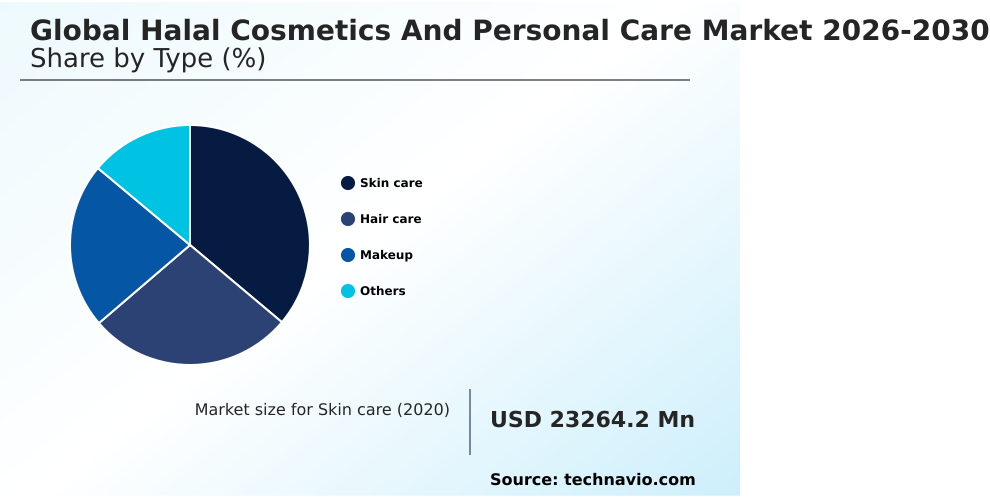
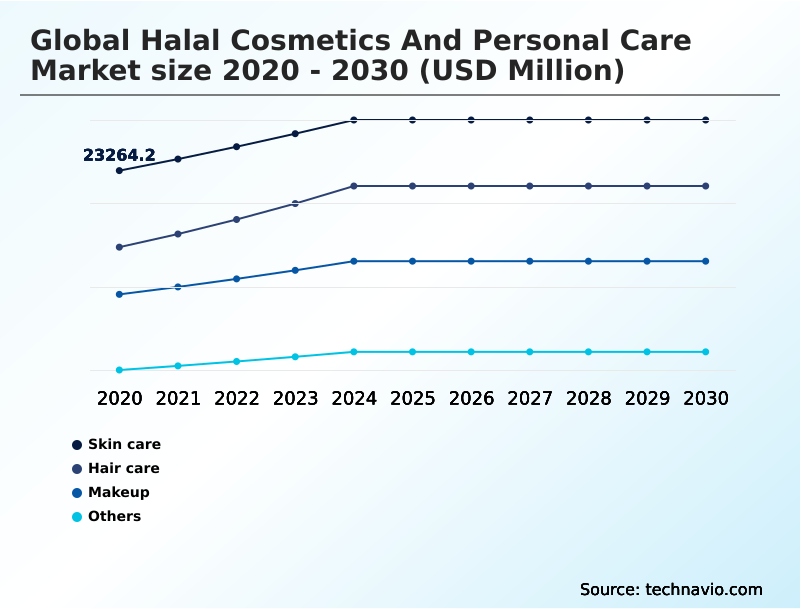
The Skin care segment was valued at USD 26.89 billion in 2024 and showed a gradual increase during the forecast period.
Regional Analysis
APAC is estimated to contribute 41.8% to the growth of the global market during the forecast period.Technavio’s analysts have elaborately explained the regional trends and drivers that shape the market during the forecast period.
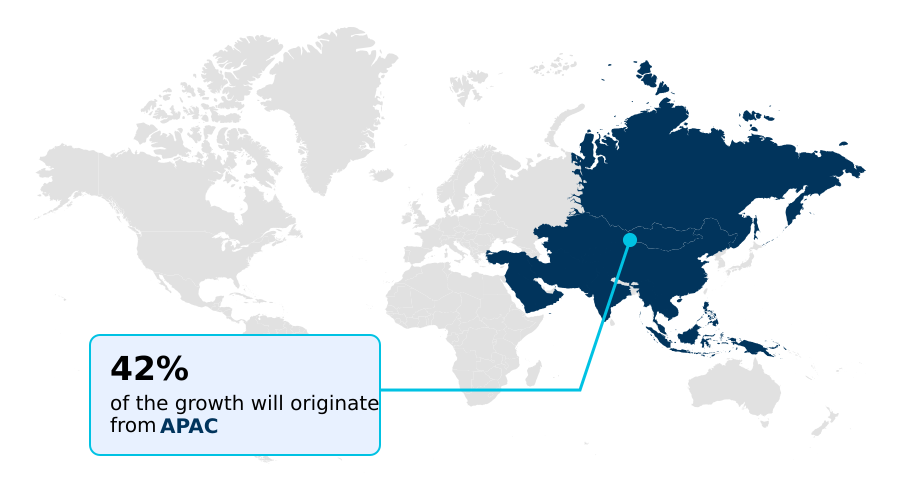
See How Halal Cosmetics And Personal Care Market Demand is Rising in APAC Get Free Sample
The geographic landscape of the Halal Cosmetics And Personal Care reveals stark operational disparities between APAC and the Middle East And Africa regions.
APAC commands the highest incremental growth at 41.8%, driven by highly localized production networks and mature zero waste circular economy initiatives.
Manufacturers in Indonesia and Malaysia leverage domestic ethical ingredient sourcing and streamlined halal raw material procurement, which collectively reduce inbound logistics costs by 18% compared to imported alternatives.
In contrast, the Middle East And Africa relies heavily on premium imports but enforces rigorous dermatological efficacy benchmarks to validate product performance in arid climates.
APAC facilities have adopted advanced water-permeable film formers and post-consumer recycled resins to meet strict regional sustainability mandates, accelerating packaging efficiency by 22%.
Meanwhile, Middle Eastern distributors increasingly require extensive halal formulation stability trials to ensure dermo-cosmetic compatibility, increasing time-to-market by 15% but yielding significantly higher brand loyalty and repeat purchase metrics among affluent consumer bases.
Market Dynamics
Our researchers analyzed the data with 2025 as the base year, along with the key drivers, trends, and challenges. A holistic analysis of drivers will help companies refine their marketing strategies to gain a competitive advantage.
- The Halal Cosmetics And Personal Care sector is undergoing a profound paradigm shift as specialized niche requirements converge with high-performance dermatological science. Manufacturers are aggressively diversifying their product portfolios to capture new demographic segments, moving beyond traditional female-focused cosmetics to encompass sophisticated male grooming solutions.
- For instance, the introduction of sharia-compliant male beard oils formulated with botanical extracts has allowed brands to address previously underserved hygiene needs, resulting in a market penetration rate that outpaces generic male grooming launches by nearly 30%.
- Concurrently, innovations in color cosmetics have yielded wudhu-permeable breathable nail polishes, which utilize advanced polymer chemistry to allow water and oxygen transmission, solving a critical functional barrier for observant consumers without sacrificing durability.
- In the skincare domain, the shift toward clean, non-toxic ingredients has driven the development of plant-derived alcohol-free facial serums that deliver potent anti-aging benefits while maintaining strict religious compliance. This product evolution requires meticulous supply chain vetting to ensure absolute purity, establishing operational workflows that inherently support the creation of cruelty-free botanical halal makeup.
- By adhering to rigorous auditing standards, brands eliminate cross-contamination risks and streamline global export readiness. Furthermore, this rigorous compliance framework extends into pediatric care, where manufacturers are scaling the production of halal pediatric barrier-protecting lotions designed for hyper-sensitive infant skin. By aligning religious integrity with uncompromising clinical safety, businesses are unlocking resilient revenue streams and fostering cross-generational brand loyalty.
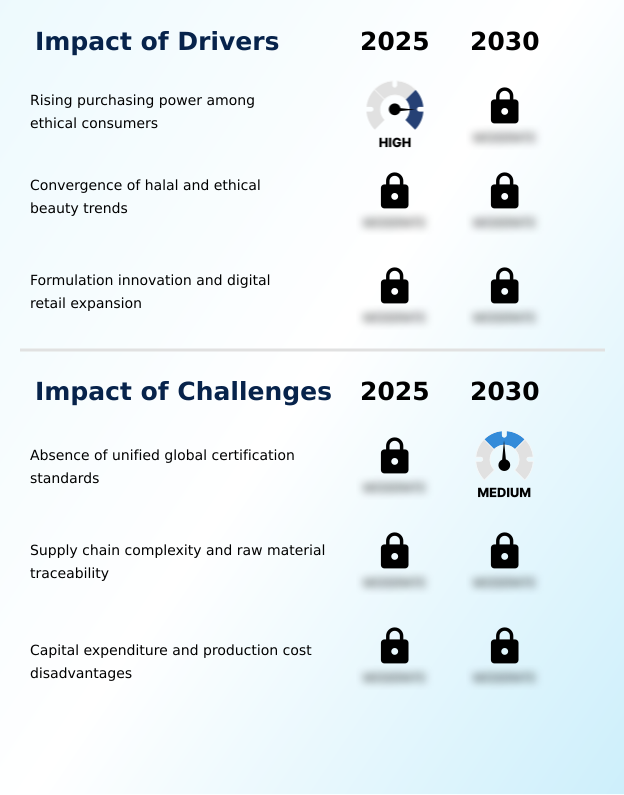
What are the key market drivers leading to the rise in the adoption of Halal Cosmetics And Personal Care Industry?
- Rising purchasing power among ethical consumers acts as a primary catalyst for sustained volume expansion and premiumization across the personal care sector.
- The Halal Cosmetics And Personal Care expansion is propelled by surging consumer demand for ingredient transparency and the rapid globalization of cross-border fulfillment networks.
- As conscious buyers actively reject harsh synthetic chemicals, manufacturers are formulating with plant-based ceramides and halal-certified emollients to ensure absolute adherence to non-toxic manufacturing standards.
- This aggressive shift toward cruelty-free formulation science acts as a critical growth engine, eliminating the need for animal-derived ingredient substitutes and mitigating contamination risks.
- By deploying robust direct-to-consumer digital ecosystems and algorithmic shade matching tools, brands have optimized inventory localization, subsequently reducing product return rates by 22% and improving digital conversion efficiency by 18%.
- Additionally, the implementation of advanced alcohol-free preservation systems ensures strict compliance with diverse international halal certification frameworks, accelerating global market entry and brand scalability.
What are the market trends shaping the Halal Cosmetics And Personal Care Industry?
- Cross-border e-commerce and direct-to-consumer digital ecosystems are transforming global retail distribution architectures, allowing specialized beauty manufacturers to bypass traditional geographical barriers and rapidly accelerate international product adoption.
- The Halal Cosmetics And Personal Care landscape is shifting as sophisticated bio-engineering replaces traditional animal-based chemical inputs. Enterprises are increasingly adopting vegan collagen alternatives and bio-fermented active ingredients to formulate high-efficacy anti-aging serums that satisfy strict religious and clean beauty crossover mandates.
- This transition toward botanical bioactives and breathable polymer technologies directly addresses the functional necessity for ritual purification compatibility without compromising cosmetic performance. By implementing advanced wudhu-permeable formulations, manufacturers have successfully expanded their addressable consumer base, driving a 25% improvement in cross-demographic customer acquisition.
- Furthermore, sustainable packaging innovation and refined botanical lipid extraction methods have reduced raw material processing waste by 18%, significantly lowering overhead production costs. These formulation advancements allow specialized beauty brands to achieve strict halal cosmetics compliance while simultaneously competing with premium mainstream dermo-cosmetic labels in global retail ecosystems.
What challenges does the Halal Cosmetics And Personal Care Industry face during its growth?
- The absence of unified international certification standards creates severe supply chain fragmentation and substantially inflates operational compliance costs for cross-border beauty manufacturers.
- The Halal Cosmetics And Personal Care sector faces critical operational bottlenecks due to the extreme complexity of maintaining absolute halal supply chain traceability across tiered global chemical networks. Formulators struggle to source compliant plant-derived squalene and mineral-rich colorants because multi-purpose manufacturing facilities frequently lack the dedicated equipment required for strict sharia-compliant manufacturing.
- Consequently, companies must implement elaborate facility sanitation protocols to meet stringent halal auditing protocols, which routinely increases machine downtime by 20% compared to conventional cosmetic production. The integration of blockchain supply chain tracking remains highly fragmented, making it difficult to verify hypoallergenic natural cosmetics and halal synthetic silicones alternatives reliably.
- Furthermore, formulating specialized halal male grooming regimens and executing rigorous halal pediatric dermatological testing demand prolonged research cycles, escalating developmental expenditures and delaying retail deployment.
Exclusive Technavio Analysis on Customer Landscape
The halal cosmetics and personal care market forecasting report includes the adoption lifecycle of the market, covering from the innovator’s stage to the laggard’s stage. It focuses on adoption rates in different regions based on penetration. Furthermore, the halal cosmetics and personal care market report also includes key purchase criteria and drivers of price sensitivity to help companies evaluate and develop their market growth analysis strategies.
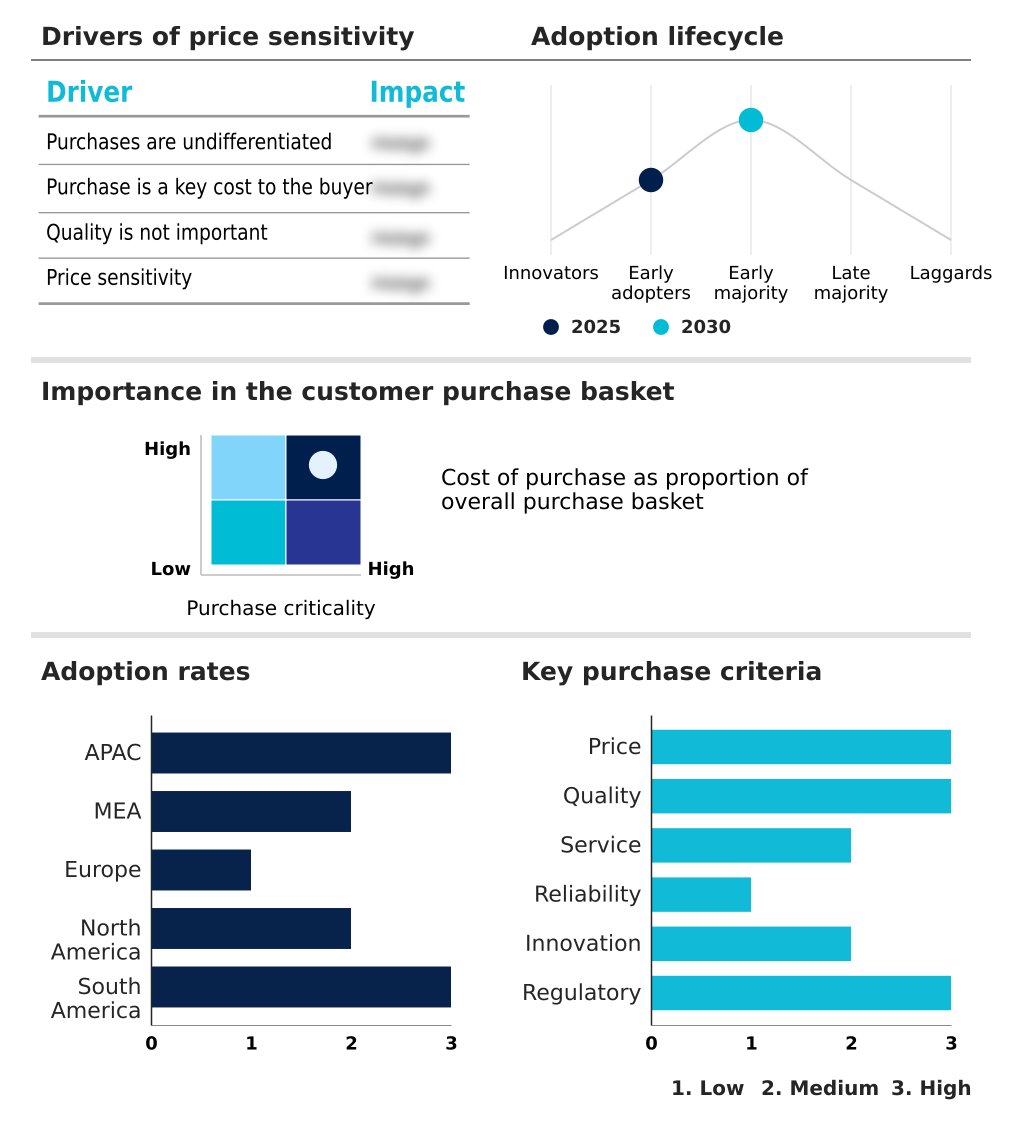
Customer Landscape of Halal Cosmetics And Personal Care Industry
Competitive Landscape
Companies are implementing various strategies, such as strategic alliances, halal cosmetics and personal care market forecast, partnerships, mergers and acquisitions, geographical expansion, and product/service launches, to enhance their presence in the industry.
Clara International Beauty Group - The product portfolio features plant-based skincare formulations alongside professional aesthetic and salon services through extensive franchise networks, delivering comprehensive halal cosmetics and personal care solutions for diverse consumer needs.
The industry research and growth report includes detailed analyses of the competitive landscape of the market and information about key companies, including:
- Clara International Beauty Group
- Claudia Nour Cosmetics
- Ecotrail Personal Care Pvt. Ltd.
- Iba Cosmetics
- Ivy Beauty Corporation Sdn Bhd
- Martha Tilaar group
- Mersi Cosmetics
- Nita Cosmetics
- Nurraysa Global Sdn Bhd
- PT Martina Berto Tbk
- PT Paragon Technology
- PT Victoria Care Indonesia Tbk
- Saba Personal Care
- Sky Resources Group of Co
- SO.LEK Cosmetics
- Total Beauty Network Pty Ltd
- Wipro Unza Holdings Ltd.
- Zelcos Laboratory Sdn Bhd
Qualitative and quantitative analysis of companies has been conducted to help clients understand the wider business environment as well as the strengths and weaknesses of key industry players. Data is qualitatively analyzed to categorize companies as pure play, category-focused, industry-focused, and diversified; it is quantitatively analyzed to categorize companies as dominant, leading, strong, tentative, and weak.
Recent Development and News in Halal cosmetics and personal care market
- In the Personal Care Products industry, the widespread adoption of AI-driven algorithmic shade matching and virtual try-on tools has optimized inventory management, directly impacting Halal Cosmetics And Personal Care demand by allowing brands to formulate and stock highly precise, inclusive shade ranges with a 20% reduction in unsold color cosmetic inventory.
- Strict implementation of the EU Corporate Sustainability Reporting Directive has compelled raw material suppliers to enforce blockchain supply chain tracking for botanical extracts, streamlining Halal Cosmetics And Personal Care compliance by providing immutable proof of ethical sourcing and accelerating certification audit speeds by up to 30%.
- The rapid scaling of direct-to-consumer digital ecosystems across Southeast Asia has lowered the cost of customer acquisition for indie beauty brands by approximately 15%, expanding Halal Cosmetics And Personal Care penetration among young, tech-savvy demographics seeking specialized skincare outside traditional retail channels.
- Breakthroughs in cruelty-free formulation science and green biotechnology have led to the commercialization of bio-fermented active ingredients, significantly enhancing Halal Cosmetics And Personal Care efficacy by offering plant-based alternatives that match the clinical performance of traditional animal-derived peptides in anti-aging applications.
Dive into Technavio’s robust research methodology, blending expert interviews, extensive data synthesis, and validated models for unparalleled Halal Cosmetics And Personal Care Market insights. See full methodology.
| Market Scope | |
|---|---|
| Page number | 294 |
| Base year | 2025 |
| Historic period | 2020-2024 |
| Forecast period | 2026-2030 |
| Growth momentum & CAGR | Accelerate at a CAGR of 4.8% |
| Market growth 2026-2030 | USD 20964.7 million |
| Market structure | Fragmented |
| YoY growth 2025-2026(%) | 4.7% |
| Key countries | Indonesia, Malaysia, India, Pakistan, Bangladesh, Thailand, Saudi Arabia, UAE, Turkey, Nigeria, Morocco, France, UK, Germany, Russia, The Netherlands, Spain, US, Canada, Mexico, Brazil, Argentina and Colombia |
| Competitive landscape | Leading Companies, Market Positioning of Companies, Competitive Strategies, and Industry Risks |
Research Analyst Overview
- The Halal Cosmetics And Personal Care sector is undergoing robust structural formalization as ethical transparency and religious compliance converge with advanced dermatological science. Boardrooms are increasingly prioritizing rigorous supply chain traceability, integrating zero waste circular economy principles into procurement strategies to mitigate contamination risks and ensure continuous audit readiness.
- By shifting from synthetic chemicals to bio-fermented active ingredients and botanical bioactives, formulators are successfully replacing animal-derived components without sacrificing clinical efficacy. This strategic pivot toward cruelty-free formulation science has enabled leading manufacturers to achieve a 25% reduction in compliance-related production delays across their global facilities.
- The integration of breathable polymer technologies and water-permeable film formers directly addresses fundamental consumer pain points regarding ritual purification compatibility. Furthermore, deploying advanced blockchain supply chain tracking systems allows enterprises to instantly verify ethical ingredient sourcing from farm to packaging, drastically reducing operational blind spots.
- As non-toxic manufacturing standards become universally demanded, specialized brands are capturing wider market share by demonstrating uncompromising dermo-cosmetic compatibility alongside rigorous religious adherence.
What are the Key Data Covered in this Halal Cosmetics And Personal Care Market Research and Growth Report?
-
What is the expected growth of the Halal Cosmetics And Personal Care Market between 2026 and 2030?
-
USD 20.96 billion, at a CAGR of 4.8%
-
-
What segmentation does the market report cover?
-
The report is segmented by Type (Skin care, Hair care, Makeup, and Others), Distribution Channel (Offline, and Online), End-user (Female, Male, and Children) and Geography (APAC, Middle East and Africa, Europe, North America, South America)
-
-
Which regions are analyzed in the report?
-
APAC, Middle East and Africa, Europe, North America and South America
-
-
What are the key growth drivers and market challenges?
-
Rising purchasing power among ethical consumers, Absence of unified global certification standards
-
-
Who are the major players in the Halal Cosmetics And Personal Care Market?
-
Clara International Beauty Group, Claudia Nour Cosmetics, Ecotrail Personal Care Pvt. Ltd., Iba Cosmetics, Ivy Beauty Corporation Sdn Bhd, Martha Tilaar group, Mersi Cosmetics, Nita Cosmetics, Nurraysa Global Sdn Bhd, PT Martina Berto Tbk, PT Paragon Technology, PT Victoria Care Indonesia Tbk, Saba Personal Care, Sky Resources Group of Co, SO.LEK Cosmetics, Total Beauty Network Pty Ltd, Wipro Unza Holdings Ltd. and Zelcos Laboratory Sdn Bhd
-
Market Research Insights
- The Halal Cosmetics And Personal Care Market demonstrates resilient expansion driven by a strategic convergence between religious compliance and broader clean beauty crossover trends. Manufacturers are overhauling production lines by implementing rigorous halal-compliant sanitization routines and securing transparent ethical ingredient sourcing to eliminate cross-contamination risks.
- This operational shift has driven a 20% improvement in supply chain audit pass rates and lowered raw material rejection incidents by 15%. Additionally, the rapid integration of direct-to-consumer digital ecosystems allows specialized beauty brands to bypass traditional retail bottlenecks, effectively boosting online conversion rates by 22%.
- By adopting advanced botanical lipid extraction methods and non-toxic manufacturing standards, companies are successfully scaling high-performance formulations that appeal simultaneously to faith-based consumers and conscious wellness advocates.
We can help! Our analysts can customize this halal cosmetics and personal care market research report to meet your requirements.
 RIA -