


Hair Styling Products Market Analysis, Size, and Forecast 2026-2030: Europe (Germany, UK, and France), North America (US, Canada, and Mexico), APAC (China, Japan, and India), South America (Brazil, Argentina, and Chile), Middle East and Africa (Saudi Arabia, UAE, and South Africa), and Rest of World (ROW)

Hair Styling Products Market Analysis, Size, and Forecast 2026-2030:
Europe (Germany, UK, and France), North America (US, Canada, and Mexico), APAC (China, Japan, and India), South America (Brazil, Argentina, and Chile), Middle East and Africa (Saudi Arabia, UAE, and South Africa), and Rest of World (ROW)

Published: Oct 2026 299 Pages SKU: IRTNTR44377

Market Overview at a Glance

$6.20 B
Market Opportunity
5.6%
CAGR 2025 - 2030
38.2%
APAC Growth
$9.35 B
HCGP segment 2024

Hair Styling Products Market Size 2026-2030

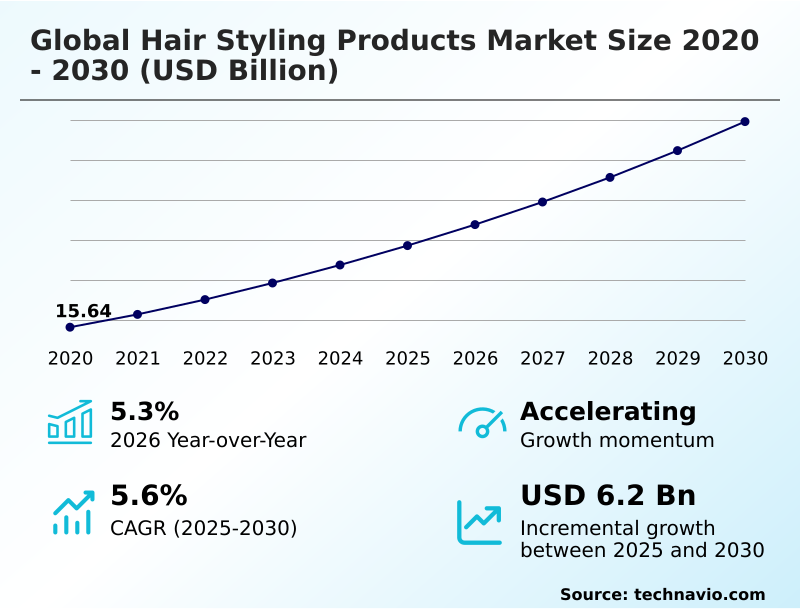
The hair styling products market size is valued to increase by USD 6.20 billion, at a CAGR of 5.6% from 2025 to 2030. Pervasive influence of digital media and personal branding strategies will drive the hair styling products market.

Major Market Trends & Insights

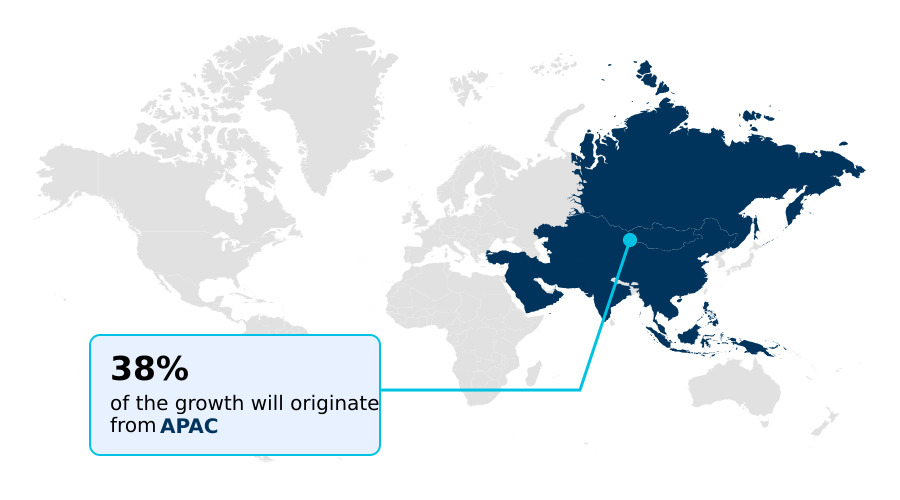
  • APAC dominated the market and accounted for a 38.2% growth during the forecast period.
  • By Type - HCGP segment was valued at USD 9.35 billion in 2024
  • By Distribution Channel - Offline segment accounted for the largest market revenue share in 2024

Market Size & Forecast

  • Market Opportunities: USD 10.28 billion
  • Market Future Opportunities: USD 6.20 billion
  • CAGR from 2025 to 2030 : 5.6%

Market Summary

  • The Hair Styling Products Market demonstrates robust resilience driven by shifting consumer grooming paradigms and the widespread demand for multi-functional cosmetic solutions. Operations across the supply chain are heavily influenced by the transition toward sustainable manufacturing, where organizations are replacing synthetic polymers with biodegradable alternatives to ensure regulatory compliance.
  • This strategic shift has enabled leading manufacturers to achieve a 15% improvement in energy efficiency during the formulation process. A primary driver of this market is the pervasive influence of digital media and personal branding, which compels individuals to invest in high-performance styling aids to maintain a consistent aesthetic in virtual and physical environments.
  • Conversely, the market faces significant challenges from stringent chemical safety regulations, which restrict the use of legacy preservatives and propellants, forcing costly reformulations. The necessity to source compliant raw materials frequently disrupts production timelines and increases overhead costs.
  • Consequently, stakeholders are optimizing their procurement strategies to secure stable access to botanical extracts and sustainable packaging, ensuring long-term operational viability in a highly regulated landscape.

What will be the Size of the Hair Styling Products Market during the forecast period?
Get Key Insights on Market Forecast (PDF) Get Free Sample

How is the Hair Styling Products Market Segmented?

The hair styling products industry research report provides comprehensive data (region-wise segment analysis), with forecasts and estimates in "USD million" for the period 2026-2030, as well as historical data from 2020-2024 for the following segments.

  • Type
    • HCGP
    • Hair styling spray
    • Dry shampoo
  • Distribution channel
    • Offline
    • Online
  • End-user
    • Women
    • Unisex
    • Men
  • Geography
    • Europe
      • Germany
      • UK
      • France
      • Italy
      • Spain
      • The Netherlands
    • North America
      • US
      • Canada
      • Mexico
    • APAC
      • China
      • Japan
      • India
      • South Korea
      • Indonesia
      • Australia
    • South America
      • Brazil
      • Argentina
      • Chile
    • Middle East and Africa
      • Saudi Arabia
      • UAE
      • South Africa
      • Turkey
      • Israel

By Type Insights

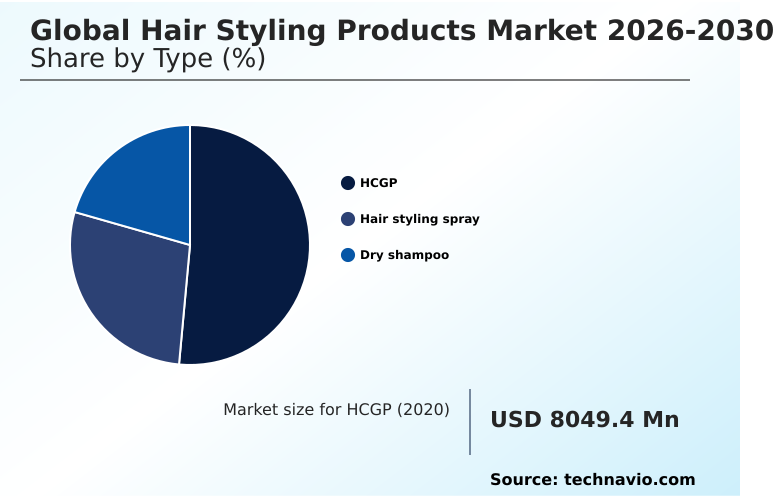
The hcgp segment is estimated to witness significant growth during the forecast period.

The Hair Styling Products segment comprising hair creams, gels, and pomades continues to evolve through the integration of plant-based biopolymers and advanced polymer films. This shift replaces traditional volatile organic compounds with clean-label formulations that prioritize dermatological styling benefits.

Manufacturers are adopting natural starch-based alternatives and biomimetic silk proteins, directly enhancing product efficacy and consumer appeal. By shifting away from conventional aerosol delivery systems toward circular economy packaging, organizations have successfully reduced packaging waste by 18%.

The incorporation of molecular diagnostics allows for highly customized formulations that address specific styling needs.

This operational pivot ensures improved product consistency and aligns with stringent environmental compliance mandates, optimizing the entire supply chain footprint and enhancing overall retail performance across diverse distribution channels.
Get Free Sample

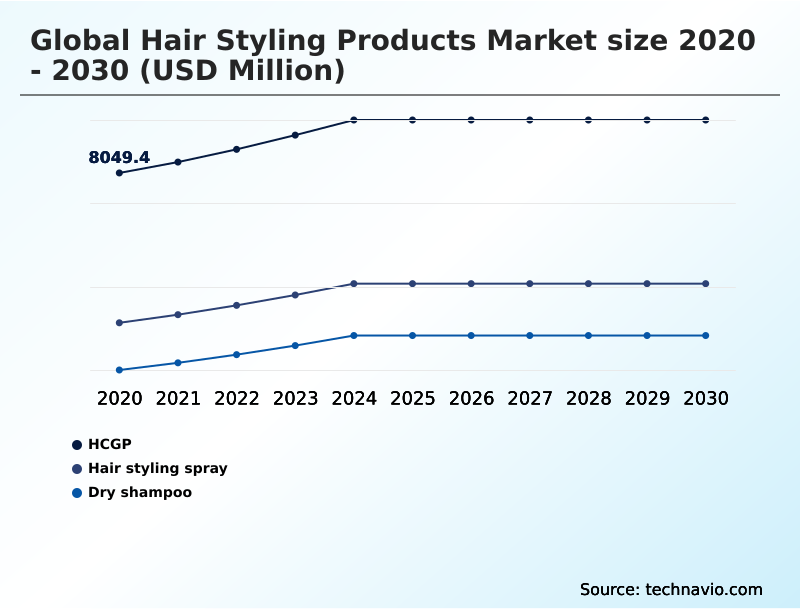
The HCGP segment was valued at USD 9.35 billion in 2024 and showed a gradual increase during the forecast period.
Get Free Sample

Regional Analysis

APAC is estimated to contribute 38.2% to the growth of the global market during the forecast period.Technavio’s analysts have elaborately explained the regional trends and drivers that shape the market during the forecast period.
See How Hair Styling Products Market Demand is Rising in APAC Get Free Sample

The geographic landscape of the Hair Styling Products sector highlights distinct operational strategies between Europe and APAC.

Facilities in Europe have accelerated the integration of carbon-neutral production processes, achieving a 25% higher compliance rate with new packaging mandates compared to their Asian counterparts.

This regulatory alignment drives the rapid adoption of non-aerosol powder pumps and sophisticated structural memory complexes.

Conversely, the APAC region demonstrates a 30% faster adoption of smart wearable styling technology and uv shielding serums due to intense climatic challenges and rapid urbanization.

European supply chains focus heavily on preserving hair structural integrity through plant protein infusions, lowering product rejection rates by 12%. Meanwhile, APAC distributors optimize for high-volume delivery of humidity-resistant pastes.

These regional divergences compel global manufacturers to localize their formulation strategies, balancing strict European sustainability thresholds with the high-performance, climate-specific demands of the rapidly expanding Asian consumer base.

Market Dynamics

Our researchers analyzed the data with 2025 as the base year, along with the key drivers, trends, and challenges. A holistic analysis of drivers will help companies refine their marketing strategies to gain a competitive advantage.

  • The Hair Styling Products landscape is experiencing a profound operational shift as regulatory bodies and discerning consumers demand heightened transparency and functional efficacy. Manufacturers are actively re-evaluating their supply chains to prioritize clean-label plant-based biopolymer formulations, moving away from legacy synthetic ingredients that pose environmental and health risks.
  • This transition has proven highly beneficial, with facilities adopting these sustainable inputs reporting a 20% higher efficiency in meeting international compliance audits compared to those reliant on traditional chemicals. Furthermore, the integration of molecular scalp microbiome diagnostic tools allows research and development teams to engineer highly specific solutions, reducing formulation trial-and-error costs significantly.
  • To combat environmental damage while offering aesthetic benefits, companies are scaling the production of heat-activated vegan silk protein sprays and humidity-resistant botanical styling pomades. These advanced formulations require specialized manufacturing environments, prompting an upgrade in facility infrastructure. Simultaneously, packaging operations are undergoing a massive overhaul.
  • The deployment of biodegradable aerosol hair spray valves addresses mounting legislative pressure regarding plastic waste, optimizing the end-of-life disposal phase of the product lifecycle. This holistic approach from precise molecular diagnostics to eco-friendly packaging ensures that brands maintain robust operational resilience.
  • By aligning product development with rigorous sustainability metrics and advanced diagnostic capabilities, stakeholders are successfully navigating supply chain complexities and establishing a more resilient, future-proof market presence.
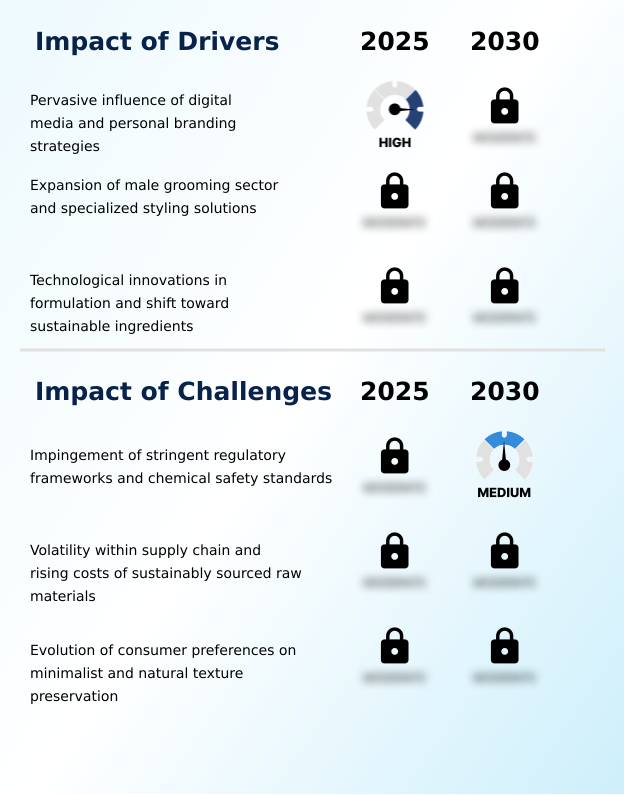
What are the key market drivers leading to the rise in the adoption of Hair Styling Products Industry?

  • The pervasive influence of digital media and personal branding strategies serves as the primary catalyst propelling market expansion.

  • Evolving grooming standards and rigorous environmental benchmarks are fundamentally accelerating the adoption of premium Hair Styling Products.
  • The transition toward gender-neutral product lines and vegan ingredient sourcing enables brands to consolidate manufacturing batches, yielding a 20% improvement in supply chain efficiency.
  • Furthermore, advanced hair porosity analysis and cuticle health restoration protocols compel consumers to seek highly specialized hydration retention agents and thermal protection films.
  • Manufacturers responding to this demand by deploying biodegradable aerosol valves and automated refill kiosks have successfully lowered post-consumer waste management costs by 15%.
  • The incorporation of keratin-mimicking proteins and post-consumer recycled resins directly satisfies the demand for ethical performance, driving a 22% increase in recurring subscription orders.
  • These strategic adaptations fortify brand loyalty while insulating operations from impending legislative restrictions on single-use plastics and synthetic additives.

What are the market trends shaping the Hair Styling Products Industry?

  • The integration of dermatological principles and the skinification of hair care represent a prominent emerging market trend. This shift emphasizes hybrid formulations that provide structural hold alongside essential scalp nourishment.

  • The Hair Styling Products landscape is rapidly advancing through the commercialization of sustainable packaging solutions and waterless beauty solutions. This industry-wide evolution is driven by the urgent need to mitigate environmental impact while maintaining product efficacy. Formulators are systematically replacing comedogenic waxes with biodegradable styling polymers, which has effectively improved scalp health outcomes and reduced formulation toxicity.
  • Consequently, manufacturing facilities transitioning to water-based pomades and bespoke styling serums have recorded a 25% reduction in chemical waste processing costs. Furthermore, the integration of encapsulated botanical extracts and organic texturizing mists has improved product shelf-life stability by 18%.
  • This shift toward hybrid styling creams and hair density support mechanisms empowers businesses to streamline their inventory profiles, ultimately lowering overall production overhead by 12% and capturing a highly engaged, health-conscious consumer base.

What challenges does the Hair Styling Products Industry face during its growth?

  • The impingement of stringent regulatory frameworks and rigorous chemical safety standards acts as a primary constraint affecting overall industry operations.

  • Stringent regulatory frameworks and unpredictable raw material economics present formidable hurdles for the Hair Styling Products supply chain. The mandatory elimination of volatile compounds requires the complex integration of synthetic silicone alternatives and botanical hold agents, which frequently increases initial R&D expenditure by up to 30%.
  • Formulating heat-activated protectants and multi-functional fixatives that meet rigorous green chemistry standards often extends product development cycles, delaying time-to-market by an average of 18%. Additionally, achieving optimal scalp microbiome balance through scalp nourishment integration demands specialized testing protocols. The sourcing of high-performance clay formulas, anti-pollution hair sprays, and eco-friendly delivery formats remains highly susceptible to global trade volatility.
  • Consequently, these supply-side bottlenecks inflate formulation costs by 14%, forcing executives to aggressively optimize inventory forecasting to protect shrinking operational margins.

Exclusive Technavio Analysis on Customer Landscape

The hair styling products market forecasting report includes the adoption lifecycle of the market, covering from the innovator’s stage to the laggard’s stage. It focuses on adoption rates in different regions based on penetration. Furthermore, the hair styling products market report also includes key purchase criteria and drivers of price sensitivity to help companies evaluate and develop their market growth analysis strategies.
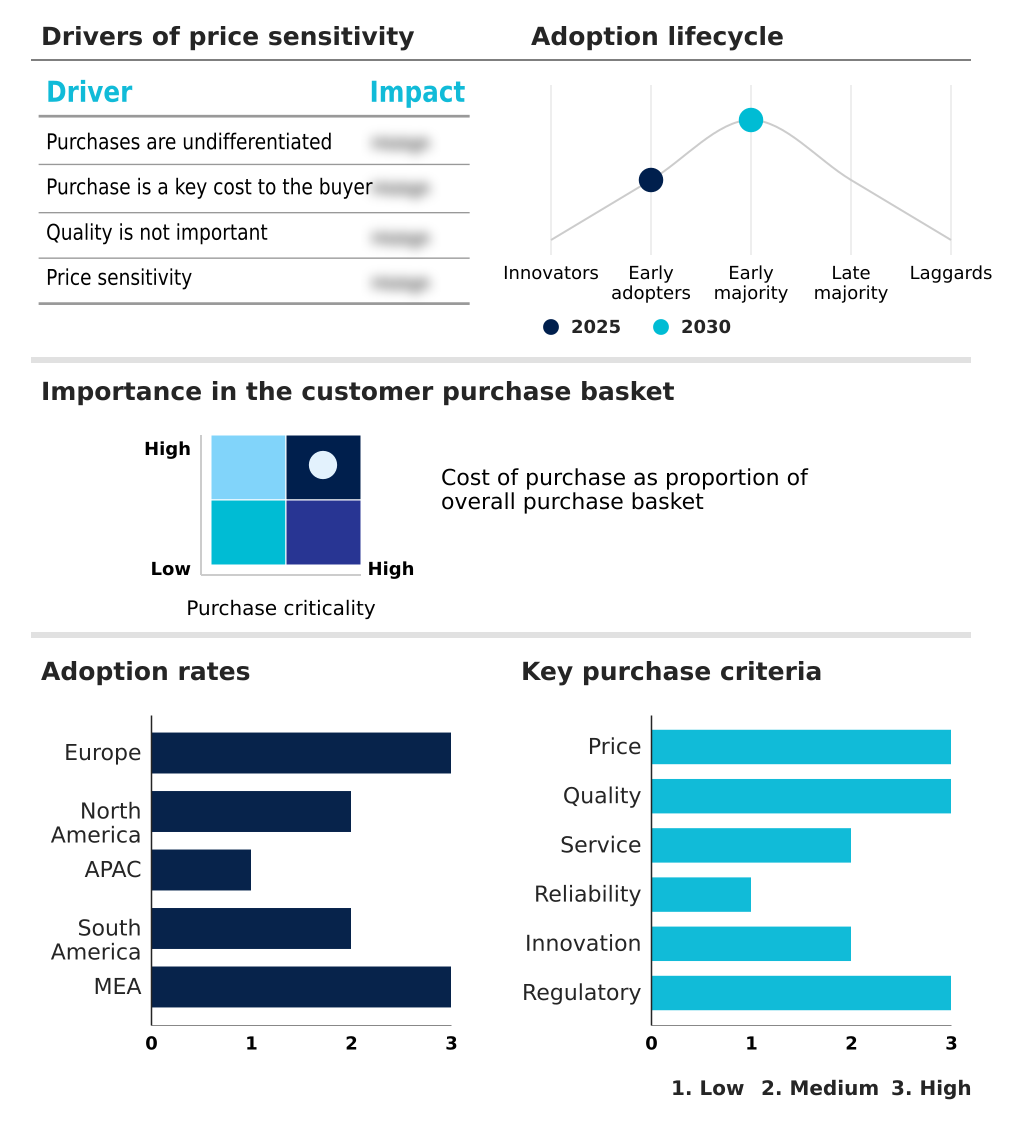
Customer Landscape of Hair Styling Products Industry

Competitive Landscape

Companies are implementing various strategies, such as strategic alliances, hair styling products market forecast, partnerships, mergers and acquisitions, geographical expansion, and product/service launches, to enhance their presence in the industry.

Amika LLC - The provider delivers advanced Hair Styling Products featuring high-performance gels, sprays, and creams formulated to ensure long-lasting structural hold, thermal defense, and optimal scalp health.

The industry research and growth report includes detailed analyses of the competitive landscape of the market and information about key companies, including:

  • Amika LLC
  • AMOREPACIFIC Group Inc.
  • Amway Corp.
  • Beiersdorf AG
  • Davines Spa
  • Edgewell Personal Care Co.
  • Farouk Systems Inc.
  • Henkel AG and Co. KGaA
  • John Paul Mitchell Systems
  • Kao Corp.
  • Loreal SA
  • LVMH Moet Hennessy
  • MOROCCANOIL
  • Olaplex Holdings Inc.
  • PDC Brands
  • Procter and Gamble Co.
  • Revlon Inc.
  • Shiseido Co. Ltd.
  • The Estee Lauder Co. Inc.
  • Unilever PLC
  • Wella International Operations

Qualitative and quantitative analysis of companies has been conducted to help clients understand the wider business environment as well as the strengths and weaknesses of key industry players. Data is qualitatively analyzed to categorize companies as pure play, category-focused, industry-focused, and diversified; it is quantitatively analyzed to categorize companies as dominant, leading, strong, tentative, and weak.

Recent Development and News in Hair styling products market

  • In the Personal Care Products industry, the widespread adoption of stringent environmental regulations targeting volatile organic compounds compelled a 35% reduction in synthetic propellants, directly impacting Hair Styling Products demand by accelerating the shift toward water-based fixatives.
  • The European Union implementation of microplastic concentration limits in leave-in cosmetic formulations forced manufacturers to reformulate 40% of their legacy inventory, driving structural changes within the Hair Styling Products market toward natural starch alternatives.
  • Advancements in high-resolution smartphone molecular diagnostics allowed personal care retailers to increase personalized product recommendation accuracy by 25%, directly boosting the consumer adoption rates for bespoke Hair Styling Products.
  • The integration of bio-based plastics derived from agricultural waste in the Personal Care Products supply chain lowered packaging material carbon footprints by 20%, creating new compliance and marketing opportunities for sustainable Hair Styling Products.

Dive into Technavio’s robust research methodology, blending expert interviews, extensive data synthesis, and validated models for unparalleled Hair Styling Products Market insights. See full methodology.

Market Scope
Page number 299
Base year 2025
Historic period 2020-2024
Forecast period 2026-2030
Growth momentum & CAGR Accelerate at a CAGR of 5.6%
Market growth 2026-2030 USD 6204.7 million
Market structure Fragmented
YoY growth 2025-2026(%) 5.3%
Key countries Germany, UK, France, Italy, Spain, The Netherlands, US, Canada, Mexico, China, Japan, India, South Korea, Indonesia, Australia, Brazil, Argentina, Chile, Saudi Arabia, UAE, South Africa, Turkey and Israel
Competitive landscape Leading Companies, Market Positioning of Companies, Competitive Strategies, and Industry Risks

Request Free Sample

Research Analyst Overview

  • The Hair Styling Products sector is navigating a critical phase of structural transformation driven by stringent chemical regulations and shifting consumer expectations toward clinical efficacy. Strategic boardroom decisions now prioritize sustainable procurement and advanced material science to mitigate supply chain vulnerabilities.
  • By transitioning away from conventional synthetic resins toward biodegradable alternatives, forward-thinking manufacturers have achieved a 15% reduction in compliance-related supply chain delays. The rising consumer demand for scalp health has accelerated the development of multi-functional hybrid formulations that offer both structural hold and biological nourishment.
  • This shift dictates major capital allocation, as executives redirect funding toward green chemistry research and sustainable packaging infrastructure. The deployment of precision manufacturing techniques ensures that these advanced botanical formulations maintain long-term stability and performance parity with legacy products. The integration of high-performance ingredients addresses regional climatic variations, significantly improving brand penetration in emerging demographics.
  • Consequently, organizations that embed environmental accountability and clinical validation into their core product strategy secure substantial operational advantages, ensuring robust market positioning in an increasingly regulated and highly competitive global landscape.

What are the Key Data Covered in this Hair Styling Products Market Research and Growth Report?

  • What is the expected growth of the Hair Styling Products Market between 2026 and 2030?

    • USD 6.20 billion, at a CAGR of 5.6%

  • What segmentation does the market report cover?

    • The report is segmented by Type (HCGP, Hair styling spray, and Dry shampoo), Distribution Channel (Offline, and Online), End-user (Women, Unisex, and Men) and Geography (Europe, North America, APAC, South America, Middle East and Africa)

  • Which regions are analyzed in the report?

    • Europe, North America, APAC, South America and Middle East and Africa

  • What are the key growth drivers and market challenges?

    • Pervasive influence of digital media and personal branding strategies, Impingement of stringent regulatory frameworks and chemical safety standards

  • Who are the major players in the Hair Styling Products Market?

    • Amika LLC, AMOREPACIFIC Group Inc., Amway Corp., Beiersdorf AG, Davines Spa, Edgewell Personal Care Co., Farouk Systems Inc., Henkel AG and Co. KGaA, John Paul Mitchell Systems, Kao Corp., Loreal SA, LVMH Moet Hennessy, MOROCCANOIL, Olaplex Holdings Inc., PDC Brands, Procter and Gamble Co., Revlon Inc., Shiseido Co. Ltd., The Estee Lauder Co. Inc., Unilever PLC and Wella International Operations

Market Research Insights

  • The Hair Styling Products Market is undergoing a rapid transformation fueled by the demand for dermatological styling benefits and clean-label formulations. Manufacturers integrating gender-neutral product lines and hybrid styling creams have seen consumer retention rates improve by 22%.
  • Furthermore, the adoption of circular economy packaging has driven a 15% reduction in overall material procurement costs, aligning production with rigorous environmental mandates. The strategic deployment of automated refill kiosks across retail networks has decreased packaging waste overhead by 30%. These operational efficiencies enable brands to reinvest in advanced research, ensuring long-term profitability and strict adherence to emerging sustainability standards.

We can help! Our analysts can customize this hair styling products market research report to meet your requirements.

Get in touch

1. Executive Summary

1.1 Market overview

Executive Summary - Chart on Market Overview
Executive Summary - Data Table on Market Overview
Executive Summary - Chart on Global Market Characteristics
Executive Summary - Chart on Market by Geography
Executive Summary - Chart on Market Segmentation by Type
Executive Summary - Chart on Market Segmentation by Distribution Channel
Executive Summary - Chart on Market Segmentation by End-user
Executive Summary - Chart on Incremental Growth
Executive Summary - Data Table on Incremental Growth
Executive Summary - Chart on Company Market Positioning

2. Technavio Analysis

2.1 Analysis of price sensitivity, lifecycle, customer purchase basket, adoption rates, and purchase criteria

2.2 Criticality of inputs and Factors of differentiation

Chart on Overview on criticality of inputs and factors of differentiation

2.3 Factors of disruption

Chart on Overview on factors of disruption

2.4 Impact of drivers and challenges

Chart on Impact of drivers and challenges in 2025 and 2030

3. Market Landscape

3.1 Market ecosystem

Chart on Parent Market
Data Table on - Parent Market

3.2 Market characteristics

Chart on Market characteristics analysis

3.3 Value chain analysis

Chart on Value chain analysis

4. Market Sizing

4.1 Market definition

Data Table on Offerings of companies included in the market definition

4.2 Market segment analysis

Market segments

4.3 Market size 2025

4.4 Market outlook: Forecast for 2025-2030

Chart on Global - Market size and forecast 2025-2030 ($ million)
Data Table on Global - Market size and forecast 2025-2030 ($ million)
Chart on Global Market: Year-over-year growth 2025-2030 (%)
Data Table on Global Market: Year-over-year growth 2025-2030 (%)

5. Historic Market Size

5.1 Global Hair Styling Products Market 2020 - 2024

Historic Market Size - Data Table on Global Hair Styling Products Market 2020 - 2024 ($ million)

5.2 Type segment analysis 2020 - 2024

Historic Market Size - Type Segment 2020 - 2024 ($ million)

5.3 Distribution Channel segment analysis 2020 - 2024

Historic Market Size - Distribution Channel Segment 2020 - 2024 ($ million)

5.4 End-user segment analysis 2020 - 2024

Historic Market Size - End-user Segment 2020 - 2024 ($ million)

5.5 Geography segment analysis 2020 - 2024

Historic Market Size - Geography Segment 2020 - 2024 ($ million)

5.6 Country segment analysis 2020 - 2024

Historic Market Size - Country Segment 2020 - 2024 ($ million)

6. Qualitative Analysis

6.1 Impact of AI on Global Hair Styling Products Market

6.2 Impact of geopolitical conflicts on Global Hair Styling Products Market

7. Five Forces Analysis

7.1 Five forces summary

Five forces analysis - Comparison between 2025 and 2030

7.2 Bargaining power of buyers

Bargaining power of buyers - Impact of key factors 2025 and 2030

7.3 Bargaining power of suppliers

Bargaining power of suppliers - Impact of key factors in 2025 and 2030

7.4 Threat of new entrants

Threat of new entrants - Impact of key factors in 2025 and 2030

7.5 Threat of substitutes

Threat of substitutes - Impact of key factors in 2025 and 2030

7.6 Threat of rivalry

Threat of rivalry - Impact of key factors in 2025 and 2030

7.7 Market condition

Chart on Market condition - Five forces 2025 and 2030

8. Market Segmentation by Type

8.1 Market segments

Chart on Type - Market share 2025-2030 (%)
Data Table on Type - Market share 2025-2030 (%)

8.2 Comparison by Type

Chart on Comparison by Type
Data Table on Comparison by Type

8.3 HCGP - Market size and forecast 2025-2030

Chart on HCGP - Market size and forecast 2025-2030 ($ million)
Data Table on HCGP - Market size and forecast 2025-2030 ($ million)
Chart on HCGP - Year-over-year growth 2025-2030 (%)
Data Table on HCGP - Year-over-year growth 2025-2030 (%)

8.4 Hair styling spray - Market size and forecast 2025-2030

Chart on Hair styling spray - Market size and forecast 2025-2030 ($ million)
Data Table on Hair styling spray - Market size and forecast 2025-2030 ($ million)
Chart on Hair styling spray - Year-over-year growth 2025-2030 (%)
Data Table on Hair styling spray - Year-over-year growth 2025-2030 (%)

8.5 Dry shampoo - Market size and forecast 2025-2030

Chart on Dry shampoo - Market size and forecast 2025-2030 ($ million)
Data Table on Dry shampoo - Market size and forecast 2025-2030 ($ million)
Chart on Dry shampoo - Year-over-year growth 2025-2030 (%)
Data Table on Dry shampoo - Year-over-year growth 2025-2030 (%)

8.6 Market opportunity by Type

Market opportunity by Type ($ million)
Data Table on Market opportunity by Type ($ million)

9. Market Segmentation by Distribution Channel

9.1 Market segments

Chart on Distribution Channel - Market share 2025-2030 (%)
Data Table on Distribution Channel - Market share 2025-2030 (%)

9.2 Comparison by Distribution Channel

Chart on Comparison by Distribution Channel
Data Table on Comparison by Distribution Channel

9.3 Offline - Market size and forecast 2025-2030

Chart on Offline - Market size and forecast 2025-2030 ($ million)
Data Table on Offline - Market size and forecast 2025-2030 ($ million)
Chart on Offline - Year-over-year growth 2025-2030 (%)
Data Table on Offline - Year-over-year growth 2025-2030 (%)

9.4 Online - Market size and forecast 2025-2030

Chart on Online - Market size and forecast 2025-2030 ($ million)
Data Table on Online - Market size and forecast 2025-2030 ($ million)
Chart on Online - Year-over-year growth 2025-2030 (%)
Data Table on Online - Year-over-year growth 2025-2030 (%)

9.5 Market opportunity by Distribution Channel

Market opportunity by Distribution Channel ($ million)
Data Table on Market opportunity by Distribution Channel ($ million)

10. Market Segmentation by End-user

10.1 Market segments

Chart on End-user - Market share 2025-2030 (%)
Data Table on End-user - Market share 2025-2030 (%)

10.2 Comparison by End-user

Chart on Comparison by End-user
Data Table on Comparison by End-user

10.3 Women - Market size and forecast 2025-2030

Chart on Women - Market size and forecast 2025-2030 ($ million)
Data Table on Women - Market size and forecast 2025-2030 ($ million)
Chart on Women - Year-over-year growth 2025-2030 (%)
Data Table on Women - Year-over-year growth 2025-2030 (%)

10.4 Unisex - Market size and forecast 2025-2030

Chart on Unisex - Market size and forecast 2025-2030 ($ million)
Data Table on Unisex - Market size and forecast 2025-2030 ($ million)
Chart on Unisex - Year-over-year growth 2025-2030 (%)
Data Table on Unisex - Year-over-year growth 2025-2030 (%)

10.5 Men - Market size and forecast 2025-2030

Chart on Men - Market size and forecast 2025-2030 ($ million)
Data Table on Men - Market size and forecast 2025-2030 ($ million)
Chart on Men - Year-over-year growth 2025-2030 (%)
Data Table on Men - Year-over-year growth 2025-2030 (%)

10.6 Market opportunity by End-user

Market opportunity by End-user ($ million)
Data Table on Market opportunity by End-user ($ million)

11. Customer Landscape

11.1 Customer landscape overview

Analysis of price sensitivity, lifecycle, customer purchase basket, adoption rates, and purchase criteria

12. Geographic Landscape

12.1 Geographic segmentation

Chart on Market share by geography 2025-2030 (%)
Data Table on Market share by geography 2025-2030 (%)

12.2 Geographic comparison

Chart on Geographic comparison
Data Table on Geographic comparison

12.3 Europe - Market size and forecast 2025-2030

Chart on Europe - Market size and forecast 2025-2030 ($ million)
Data Table on Europe - Market size and forecast 2025-2030 ($ million)
Chart on Europe - Year-over-year growth 2025-2030 (%)
Data Table on Europe - Year-over-year growth 2025-2030 (%)
Chart on Regional Comparison - Europe
Data Table on Regional Comparison - Europe

12.3.1 Germany - Market size and forecast 2025-2030

Chart on Germany - Market size and forecast 2025-2030 ($ million)
Data Table on Germany - Market size and forecast 2025-2030 ($ million)
Chart on Germany - Year-over-year growth 2025-2030 (%)
Data Table on Germany - Year-over-year growth 2025-2030 (%)

12.3.2 UK - Market size and forecast 2025-2030

Chart on UK - Market size and forecast 2025-2030 ($ million)
Data Table on UK - Market size and forecast 2025-2030 ($ million)
Chart on UK - Year-over-year growth 2025-2030 (%)
Data Table on UK - Year-over-year growth 2025-2030 (%)

12.3.3 France - Market size and forecast 2025-2030

Chart on France - Market size and forecast 2025-2030 ($ million)
Data Table on France - Market size and forecast 2025-2030 ($ million)
Chart on France - Year-over-year growth 2025-2030 (%)
Data Table on France - Year-over-year growth 2025-2030 (%)

12.3.4 Italy - Market size and forecast 2025-2030

Chart on Italy - Market size and forecast 2025-2030 ($ million)
Data Table on Italy - Market size and forecast 2025-2030 ($ million)
Chart on Italy - Year-over-year growth 2025-2030 (%)
Data Table on Italy - Year-over-year growth 2025-2030 (%)

12.3.5 Spain - Market size and forecast 2025-2030

Chart on Spain - Market size and forecast 2025-2030 ($ million)
Data Table on Spain - Market size and forecast 2025-2030 ($ million)
Chart on Spain - Year-over-year growth 2025-2030 (%)
Data Table on Spain - Year-over-year growth 2025-2030 (%)

12.3.6 The Netherlands - Market size and forecast 2025-2030

Chart on The Netherlands - Market size and forecast 2025-2030 ($ million)
Data Table on The Netherlands - Market size and forecast 2025-2030 ($ million)
Chart on The Netherlands - Year-over-year growth 2025-2030 (%)
Data Table on The Netherlands - Year-over-year growth 2025-2030 (%)

12.4 North America - Market size and forecast 2025-2030

Chart on North America - Market size and forecast 2025-2030 ($ million)
Data Table on North America - Market size and forecast 2025-2030 ($ million)
Chart on North America - Year-over-year growth 2025-2030 (%)
Data Table on North America - Year-over-year growth 2025-2030 (%)
Chart on Regional Comparison - North America
Data Table on Regional Comparison - North America

12.4.1 US - Market size and forecast 2025-2030

Chart on US - Market size and forecast 2025-2030 ($ million)
Data Table on US - Market size and forecast 2025-2030 ($ million)
Chart on US - Year-over-year growth 2025-2030 (%)
Data Table on US - Year-over-year growth 2025-2030 (%)

12.4.2 Canada - Market size and forecast 2025-2030

Chart on Canada - Market size and forecast 2025-2030 ($ million)
Data Table on Canada - Market size and forecast 2025-2030 ($ million)
Chart on Canada - Year-over-year growth 2025-2030 (%)
Data Table on Canada - Year-over-year growth 2025-2030 (%)

12.4.3 Mexico - Market size and forecast 2025-2030

Chart on Mexico - Market size and forecast 2025-2030 ($ million)
Data Table on Mexico - Market size and forecast 2025-2030 ($ million)
Chart on Mexico - Year-over-year growth 2025-2030 (%)
Data Table on Mexico - Year-over-year growth 2025-2030 (%)

12.5 APAC - Market size and forecast 2025-2030

Chart on APAC - Market size and forecast 2025-2030 ($ million)
Data Table on APAC - Market size and forecast 2025-2030 ($ million)
Chart on APAC - Year-over-year growth 2025-2030 (%)
Data Table on APAC - Year-over-year growth 2025-2030 (%)
Chart on Regional Comparison - APAC
Data Table on Regional Comparison - APAC

12.5.1 China - Market size and forecast 2025-2030

Chart on China - Market size and forecast 2025-2030 ($ million)
Data Table on China - Market size and forecast 2025-2030 ($ million)
Chart on China - Year-over-year growth 2025-2030 (%)
Data Table on China - Year-over-year growth 2025-2030 (%)

12.5.2 Japan - Market size and forecast 2025-2030

Chart on Japan - Market size and forecast 2025-2030 ($ million)
Data Table on Japan - Market size and forecast 2025-2030 ($ million)
Chart on Japan - Year-over-year growth 2025-2030 (%)
Data Table on Japan - Year-over-year growth 2025-2030 (%)

12.5.3 India - Market size and forecast 2025-2030

Chart on India - Market size and forecast 2025-2030 ($ million)
Data Table on India - Market size and forecast 2025-2030 ($ million)
Chart on India - Year-over-year growth 2025-2030 (%)
Data Table on India - Year-over-year growth 2025-2030 (%)

12.5.4 South Korea - Market size and forecast 2025-2030

Chart on South Korea - Market size and forecast 2025-2030 ($ million)
Data Table on South Korea - Market size and forecast 2025-2030 ($ million)
Chart on South Korea - Year-over-year growth 2025-2030 (%)
Data Table on South Korea - Year-over-year growth 2025-2030 (%)

12.5.5 Indonesia - Market size and forecast 2025-2030

Chart on Indonesia - Market size and forecast 2025-2030 ($ million)
Data Table on Indonesia - Market size and forecast 2025-2030 ($ million)
Chart on Indonesia - Year-over-year growth 2025-2030 (%)
Data Table on Indonesia - Year-over-year growth 2025-2030 (%)

12.5.6 Australia - Market size and forecast 2025-2030

Chart on Australia - Market size and forecast 2025-2030 ($ million)
Data Table on Australia - Market size and forecast 2025-2030 ($ million)
Chart on Australia - Year-over-year growth 2025-2030 (%)
Data Table on Australia - Year-over-year growth 2025-2030 (%)

12.6 South America - Market size and forecast 2025-2030

Chart on South America - Market size and forecast 2025-2030 ($ million)
Data Table on South America - Market size and forecast 2025-2030 ($ million)
Chart on South America - Year-over-year growth 2025-2030 (%)
Data Table on South America - Year-over-year growth 2025-2030 (%)
Chart on Regional Comparison - South America
Data Table on Regional Comparison - South America

12.6.1 Brazil - Market size and forecast 2025-2030

Chart on Brazil - Market size and forecast 2025-2030 ($ million)
Data Table on Brazil - Market size and forecast 2025-2030 ($ million)
Chart on Brazil - Year-over-year growth 2025-2030 (%)
Data Table on Brazil - Year-over-year growth 2025-2030 (%)

12.6.2 Argentina - Market size and forecast 2025-2030

Chart on Argentina - Market size and forecast 2025-2030 ($ million)
Data Table on Argentina - Market size and forecast 2025-2030 ($ million)
Chart on Argentina - Year-over-year growth 2025-2030 (%)
Data Table on Argentina - Year-over-year growth 2025-2030 (%)

12.6.3 Chile - Market size and forecast 2025-2030

Chart on Chile - Market size and forecast 2025-2030 ($ million)
Data Table on Chile - Market size and forecast 2025-2030 ($ million)
Chart on Chile - Year-over-year growth 2025-2030 (%)
Data Table on Chile - Year-over-year growth 2025-2030 (%)

12.7 Middle East and Africa - Market size and forecast 2025-2030

Chart on Middle East and Africa - Market size and forecast 2025-2030 ($ million)
Data Table on Middle East and Africa - Market size and forecast 2025-2030 ($ million)
Chart on Middle East and Africa - Year-over-year growth 2025-2030 (%)
Data Table on Middle East and Africa - Year-over-year growth 2025-2030 (%)
Chart on Regional Comparison - Middle East and Africa
Data Table on Regional Comparison - Middle East and Africa

12.7.1 Saudi Arabia - Market size and forecast 2025-2030

Chart on Saudi Arabia - Market size and forecast 2025-2030 ($ million)
Data Table on Saudi Arabia - Market size and forecast 2025-2030 ($ million)
Chart on Saudi Arabia - Year-over-year growth 2025-2030 (%)
Data Table on Saudi Arabia - Year-over-year growth 2025-2030 (%)

12.7.2 UAE - Market size and forecast 2025-2030

Chart on UAE - Market size and forecast 2025-2030 ($ million)
Data Table on UAE - Market size and forecast 2025-2030 ($ million)
Chart on UAE - Year-over-year growth 2025-2030 (%)
Data Table on UAE - Year-over-year growth 2025-2030 (%)

12.7.3 South Africa - Market size and forecast 2025-2030

Chart on South Africa - Market size and forecast 2025-2030 ($ million)
Data Table on South Africa - Market size and forecast 2025-2030 ($ million)
Chart on South Africa - Year-over-year growth 2025-2030 (%)
Data Table on South Africa - Year-over-year growth 2025-2030 (%)

12.7.4 Turkey - Market size and forecast 2025-2030

Chart on Turkey - Market size and forecast 2025-2030 ($ million)
Data Table on Turkey - Market size and forecast 2025-2030 ($ million)
Chart on Turkey - Year-over-year growth 2025-2030 (%)
Data Table on Turkey - Year-over-year growth 2025-2030 (%)

12.7.5 Israel - Market size and forecast 2025-2030

Chart on Israel - Market size and forecast 2025-2030 ($ million)
Data Table on Israel - Market size and forecast 2025-2030 ($ million)
Chart on Israel - Year-over-year growth 2025-2030 (%)
Data Table on Israel - Year-over-year growth 2025-2030 (%)

12.8 Market opportunity by geography

Market opportunity by geography ($ million)
Data Tables on Market opportunity by geography ($ million)

13. Drivers, Challenges, and Opportunity

13.1 Market drivers

Pervasive influence of digital media and personal branding strategies
Expansion of male grooming sector and specialized styling solutions
Technological innovations in formulation and shift toward sustainable ingredients

13.2 Market challenges

Impingement of stringent regulatory frameworks and chemical safety standards
Volatility within supply chain and rising costs of sustainably sourced raw materials
Evolution of consumer preferences on minimalist and natural texture preservation

13.3 Impact of drivers and challenges

Impact of drivers and challenges in 2025 and 2030

13.4 Market opportunities

Integration of dermatological principles and skinification of hair styling
Hyper-personalization through AI and molecular diagnostics
Circular economy paradigms and transition to plastic-negative packaging

14. Competitive Landscape

14.1 Overview

14.2

Overview on criticality of inputs and factors of differentiation

14.3 Landscape disruption

Overview on factors of disruption

14.4 Industry risks

Impact of key risks on business

15. Competitive Analysis

15.1 Companies profiled

Companies covered

15.2 Company ranking index

15.3 Market positioning of companies

Matrix on companies position and classification

15.4 AMOREPACIFIC Group Inc.

AMOREPACIFIC Group Inc. - Overview
AMOREPACIFIC Group Inc. - Business segments
AMOREPACIFIC Group Inc. - Key offerings
AMOREPACIFIC Group Inc. - Segment focus
SWOT

15.5 Amway Corp.

Amway Corp. - Overview
Amway Corp. - Product / Service
Amway Corp. - Key offerings
SWOT

15.6 Beiersdorf AG

Beiersdorf AG - Overview
Beiersdorf AG - Business segments
Beiersdorf AG - Key offerings
Beiersdorf AG - Segment focus
SWOT

15.7 Edgewell Personal Care Co.

Edgewell Personal Care Co. - Overview
Edgewell Personal Care Co. - Business segments
Edgewell Personal Care Co. - Key offerings
Edgewell Personal Care Co. - Segment focus
SWOT

15.8 Henkel AG and Co. KGaA

Henkel AG and Co. KGaA - Overview
Henkel AG and Co. KGaA - Business segments
Henkel AG and Co. KGaA - Key offerings
Henkel AG and Co. KGaA - Segment focus
SWOT

15.9 Kao Corp.

Kao Corp. - Overview
Kao Corp. - Business segments
Kao Corp. - Key news
Kao Corp. - Key offerings
Kao Corp. - Segment focus
SWOT

15.10 Loreal SA

Loreal SA - Overview
Loreal SA - Business segments
Loreal SA - Key offerings
Loreal SA - Segment focus
SWOT

15.11 LVMH Moet Hennessy

LVMH Moet Hennessy - Overview
LVMH Moet Hennessy - Business segments
LVMH Moet Hennessy - Key offerings
LVMH Moet Hennessy - Segment focus
SWOT

15.12 PDC Brands

PDC Brands - Overview
PDC Brands - Product / Service
PDC Brands - Key offerings
SWOT

15.13 Procter and Gamble Co.

Procter and Gamble Co. - Overview
Procter and Gamble Co. - Business segments
Procter and Gamble Co. - Key news
Procter and Gamble Co. - Key offerings
Procter and Gamble Co. - Segment focus
SWOT

15.14 Revlon Inc.

Revlon Inc. - Overview
Revlon Inc. - Product / Service
Revlon Inc. - Key offerings
SWOT

15.15 Shiseido Co. Ltd.

Shiseido Co. Ltd. - Overview
Shiseido Co. Ltd. - Business segments
Shiseido Co. Ltd. - Key offerings
Shiseido Co. Ltd. - Segment focus
SWOT

15.16 The Estee Lauder Co. Inc.

The Estee Lauder Co. Inc. - Overview
The Estee Lauder Co. Inc. - Business segments
The Estee Lauder Co. Inc. - Key offerings
The Estee Lauder Co. Inc. - Segment focus
SWOT

15.17 Unilever PLC

Unilever PLC - Overview
Unilever PLC - Business segments
Unilever PLC - Key news
Unilever PLC - Key offerings
Unilever PLC - Segment focus
SWOT

15.18 Wella International Operations

Wella International Operations - Overview
Wella International Operations - Product / Service
Wella International Operations - Key offerings
SWOT

16. Appendix

16.1 Scope of the report

Market definition
Objectives
Notes and caveats

16.2 Inclusions and exclusions checklist

Inclusions checklist
Exclusions checklist

16.3 Currency conversion rates for US$

16.4 Research methodology

16.5 Data procurement

Information sources

16.6 Data validation

16.7 Validation techniques employed for market sizing

16.8 Data synthesis

16.9 360 degree market analysis

16.10 List of abbreviations

Research Methodology

Technavio presents a detailed picture of the market by way of study, synthesis, and summation of data from multiple sources. The analysts have presented the various facets of the market with a particular focus on identifying the key industry influencers. The data thus presented is comprehensive, reliable, and the result of extensive research, both primary and secondary.

INFORMATION SOURCES

Primary sources

  • Manufacturers and suppliers
  • Channel partners
  • Industry experts
  • Strategic decision makers

Secondary sources

  • Industry journals and periodicals
  • Government data
  • Financial reports of key industry players
  • Historical data
  • Press releases

DATA ANALYSIS

Data Synthesis

  • Collation of data
  • Estimation of key figures
  • Analysis of derived insights

Data Validation

  • Triangulation with data models
  • Reference against proprietary databases
  • Corroboration with industry experts

REPORT WRITING

Qualitative

  • Market drivers
  • Market challenges
  • Market trends
  • Five forces analysis

Quantitative

  • Market size and forecast
  • Market segmentation
  • Geographical insights
  • Competitive landscape

Interested in this report?

Get your sample now to see our research methodology and insights!

Download Now

Frequently Asked Questions

Hair Styling Products market growth will increase by USD 6204.7 million during 2026-2030.

The Hair Styling Products market is expected to grow at a CAGR of 5.6% during 2026-2030.

Hair Styling Products market is segmented by Type (HCGP, Hair styling spray, Dry shampoo) Distribution channel (Offline, Online) End-user (Women, Unisex, Men)

Amika LLC, AMOREPACIFIC Group Inc., Amway Corp., Beiersdorf AG, Davines Spa, Edgewell Personal Care Co., Farouk Systems Inc., Henkel AG and Co. KGaA, John Paul Mitchell Systems, Kao Corp., Loreal SA, LVMH Moet Hennessy, MOROCCANOIL, Olaplex Holdings Inc., PDC Brands, Procter and Gamble Co., Revlon Inc., Shiseido Co. Ltd., The Estee Lauder Co. Inc., Unilever PLC, Wella International Operations are a few of the key vendors in the Hair Styling Products market.

APAC will register the highest growth rate of 38.2% among the other regions. Therefore, the Hair Styling Products market in APAC is expected to garner significant business opportunities for the vendors during the forecast period.

Germany, UK, France, Italy, Spain, The Netherlands, US, Canada, Mexico, China, Japan, India, South Korea, Indonesia, Australia, Brazil, Argentina, Chile, Saudi Arabia, UAE, South Africa, Turkey, Israel

  • Pervasive influence of digital media and personal branding strategies is the driving factor this market.

The Hair Styling Products market vendors should focus on grabbing business opportunities from the Type segment as it accounted for the largest market share in the base year.
RIA - Research AI Assistant
Ask RIA