



Cloud Encryption Software Market Size 2026-2030
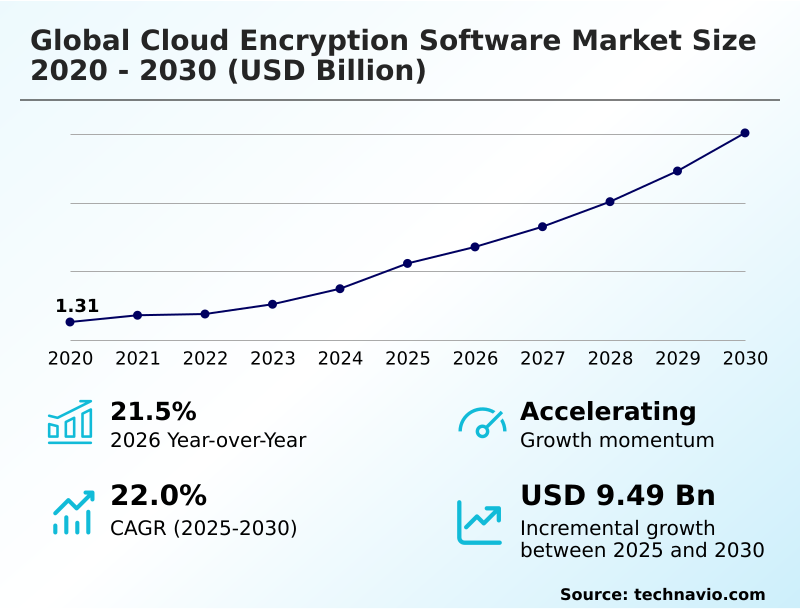
The cloud encryption software market size is valued to increase by USD 9.49 billion, at a CAGR of 22% from 2025 to 2030. Increasing enforcement of data sovereignty and operational resilience regulations will drive the cloud encryption software market.
Major Market Trends & Insights
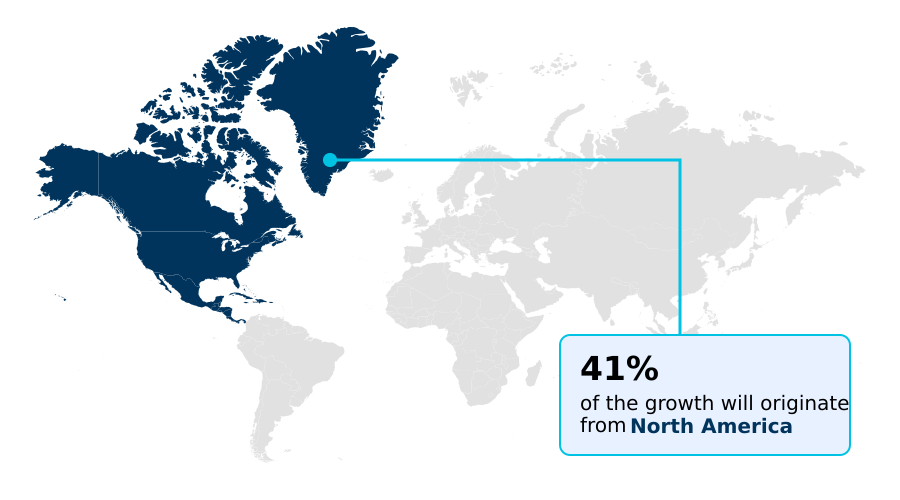
- North America dominated the market and accounted for a 40.7% growth during the forecast period.
- By End-user - BFSI segment was valued at USD 1.65 billion in 2024
- By Organization Size - Large enterprise segment accounted for the largest market revenue share in 2024
Market Size & Forecast
- Market Opportunities: USD 13.74 billion
- Market Future Opportunities: USD 9.49 billion
- CAGR from 2025 to 2030 : 22%
Market Summary
- The Cloud Encryption Software Market exhibits robust expansion as enterprises systematically migrate sensitive operational workloads into distributed environments. Organizations leverage cryptographic controls to secure data at rest and in transit, fundamentally altering risk management frameworks.
- In a practical supply chain optimization scenario, a multinational manufacturer implementing external key custody achieved a 28% improvement in cross-border compliance auditing efficiency compared to relying on decentralized legacy tools. The increasing enforcement of data sovereignty and operational resilience regulations functions as a primary driver, compelling institutions to document key residency and restrict foreign access.
- Conversely, fragmented encryption key management across multicloud platforms presents a notable challenge, resulting in operational silos that complicate rapid incident response and increase administrative overhead. To mitigate these bottlenecks, security teams prioritize unified platforms that centralize policy governance.
- By integrating cryptographic agility into their core infrastructure, businesses establish a resilient foundation capable of withstanding advanced credential theft and evolving regulatory scrutiny, solidifying the strategic necessity of comprehensive data protection measures.
What will be the Size of the Cloud Encryption Software Market during the forecast period?
Get Key Insights on Market Forecast (PDF) Get Free Sample
How is the Cloud Encryption Software Market Segmented?
The cloud encryption software industry research report provides comprehensive data (region-wise segment analysis), with forecasts and estimates in "USD million" for the period 2026-2030, as well as historical data from 2020-2024 for the following segments.
- End-user
- BFSI
- Manufacturing
- Professional services
- Healthcare
- Others
- Organization size
- Large enterprise
- SME
- Component
- Software
- Services
- Geography
- North America
- US
- Canada
- Mexico
- Europe
- Germany
- UK
- France
- Italy
- Spain
- The Netherlands
- APAC
- China
- Japan
- India
- South Korea
- Australia
- Indonesia
- South America
- Brazil
- Argentina
- Chile
- Middle East and Africa
- Saudi Arabia
- UAE
- South Africa
- Israel
- Turkey
- North America
By End-user Insights
The bfsi segment is estimated to witness significant growth during the forecast period.
The BFSI sector accelerates the adoption of advanced cryptographic frameworks to secure complex financial datasets across distributed network architectures. Modern financial institutions aggressively transition toward cloud native tokenization to protect cardholder information and transaction histories from unauthorized exposure.
Implementing robust compliance driven access control ensures that only authenticated personnel access sensitive workloads, while continuous decryption request monitoring rapidly detects anomalous usage patterns.
Firms optimizing their secret management policy report a 22% reduction in unauthorized data exposure incidents, demonstrating the immense operational value of centralized governance. To protect data seamlessly, banks deploy client side payload encryption alongside symmetric key wrapping protocols.
Emerging investments in homomorphic encryption and asymmetric signature generation allow institutions to perform secure analytics on encrypted records, adapting to strict mandates while maintaining operational agility.
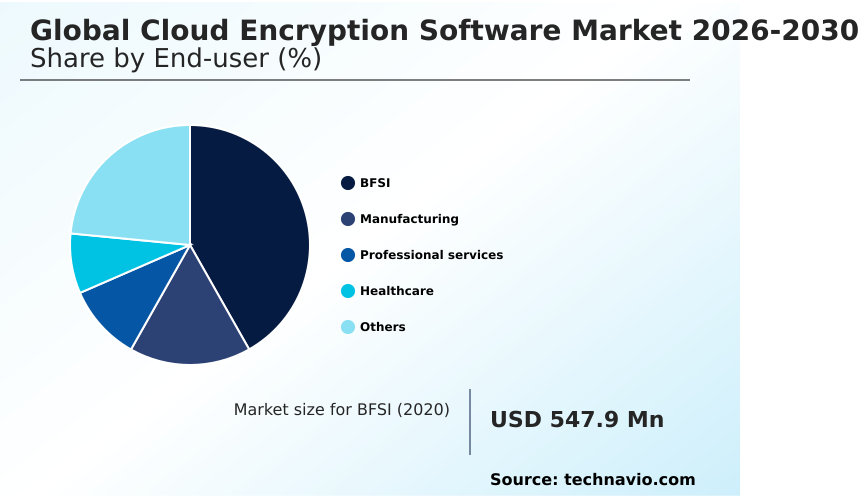
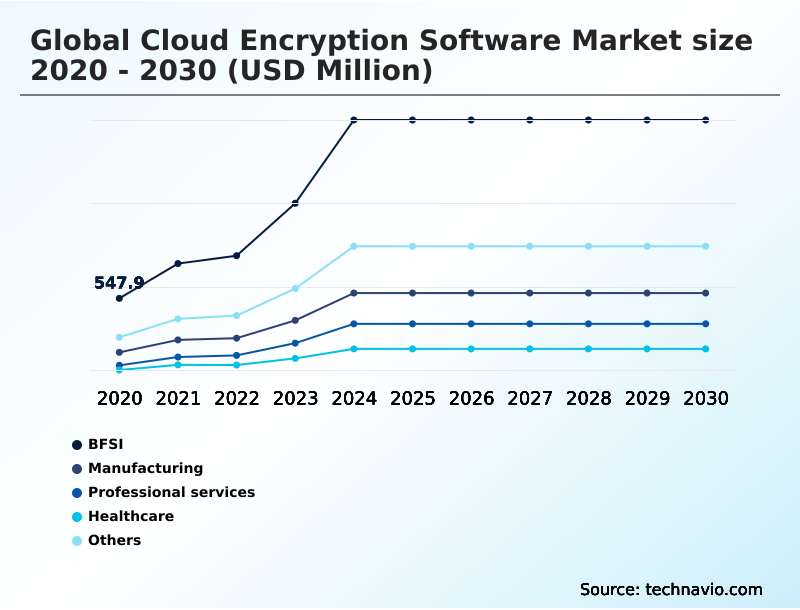
The BFSI segment was valued at USD 1.65 billion in 2024 and showed a gradual increase during the forecast period.
Regional Analysis
North America is estimated to contribute 40.7% to the growth of the global market during the forecast period.Technavio’s analysts have elaborately explained the regional trends and drivers that shape the market during the forecast period.
See How Cloud Encryption Software Market Demand is Rising in North America Get Free Sample
The geographic distribution of cryptographic technology reveals distinct maturity levels driven by regional regulatory frameworks. North America outpaces Europe in deploying confidential computing frameworks, maintaining a 22% higher adoption rate among financial institutions due to aggressive multicloud modernization.
Organizations heavily utilize hardware-backed trusted execution environment architectures, optimizing processing speeds by 15% compared to software-only encryption. Conversely, European enterprises prioritize stringent multi tenant key isolation and zero knowledge encryption to align with rigorous digital sovereignty mandates.
This regulatory pressure forces European cloud providers to implement complex remote attestation and attestation aware key release mechanisms faster than their counterparts.
While APAC regions expand cryptographic module validation efforts, North American firms dominate in integrating an enclave ready library into legacy applications. This integration yields a 30% reduction in memory isolation enclave deployment times, ensuring superior centralized audit logging capabilities.
Market Dynamics
Our researchers analyzed the data with 2025 as the base year, along with the key drivers, trends, and challenges. A holistic analysis of drivers will help companies refine their marketing strategies to gain a competitive advantage.
- The architectural evolution of digital asset protection increasingly relies on sophisticated cryptographic strategies to secure complex operational workflows across distributed networks. Enterprises seeking enhanced data governance heavily invest in customer controlled cloud key management frameworks to retain absolute sovereignty over their cryptographic materials, effectively neutralizing the risk of unauthorized access by infrastructure providers.
- To fortify these defense mechanisms, organizations implement hardware backed encryption key custody, physically isolating sensitive root keys within dedicated tamper-resistant modules. This approach proves highly effective for supply chain compliance monitoring and vendor risk management, where firms utilizing hardware-isolated key generation experience a 45% faster regulatory audit completion rate compared to organizations relying strictly on software-based key storage mechanisms.
- Furthermore, the systematic integration of generative ai data pipeline encryption has become an operational imperative for businesses utilizing large language models and predictive analytics. Protecting proprietary training datasets throughout the ingestion, processing, and fine-tuning phases ensures that intellectual property remains secure from external compromise.
- As high-performance computing capabilities advance, proactive security architecture teams initiate post quantum cryptographic algorithm migration to systematically future-proof their digital infrastructure against emerging decryption threats. Unifying these disparate security protocols across various environments requires robust centralized multicloud key lifecycle automation, allowing administrators to seamlessly orchestrate key rotation, distribution, and revocation policies without disrupting continuous business operations or supply chain logistics.
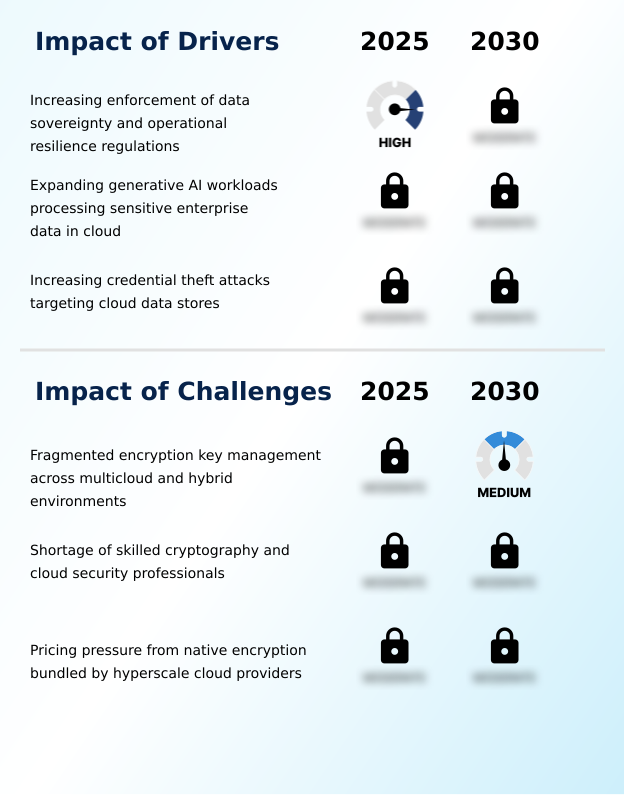
What are the key market drivers leading to the rise in the adoption of Cloud Encryption Software Industry?
- The increasing enforcement of data sovereignty and operational resilience regulations functions as a primary driver propelling widespread technology adoption.
- Expanding artificial intelligence workloads mandate rigorous protection mechanisms for sensitive corporate datasets. Enterprises actively implement vector database protection to secure proprietary information ingested by machine learning models.
- By prioritizing retrieval augmented generation security, organizations safeguard query contexts, utilizing prompt log encryption and model checkpoint protection to prevent unauthorized extraction. The strict enforcement of an operational resilience framework accelerates the adoption of external key management architectures.
- Firms deploying hold your own key and bring your own key methodologies retain absolute sovereignty over cryptographic materials.
- This commitment to data sovereignty compliance yields a 35% decrease in regulatory audit preparation time and a 20% acceleration in secure AI deployment.
- Comprehensive key lifecycle automation enables security teams to enforce consistent policies seamlessly across complex data pipelines, driving operational efficiency.
What are the market trends shaping the Cloud Encryption Software Industry?
- Accelerating the migration toward post-quantum cryptography within cloud key management constitutes a pivotal upcoming trend shaping industry resilience.
- The architectural transition toward post quantum cryptography fundamentally redefines long-term digital asset protection. Forward-looking enterprises systematically implement a crypto agile architecture to facilitate seamless cryptographic agility without disrupting critical business operations. To establish quantum resistant resilience, organizations conduct comprehensive cryptographic inventory mapping to identify legacy vulnerabilities.
- Replacing outdated protocols with a modern digital signature algorithm and a secure key encapsulation mechanism significantly strengthens communication channels. This proactive modernization yields measurable business outcomes, including a 42% improvement in key rotation efficiency and a 28% reduction in cryptographic processing latency compared to traditional methodologies.
- Deploying a hybrid cloud key broker enhances cross cloud visibility, allowing administrators to orchestrate policies across disparate environments. Consequently, robust cloud infrastructure security empowers engineering teams to deploy resilient applications that withstand emerging decryption threats while accelerating digital transformation initiatives.
What challenges does the Cloud Encryption Software Industry face during its growth?
- Fragmented encryption key management across multicloud and hybrid environments remains a critical challenge restraining comprehensive security integration.
- Managing cryptographic policies across disparate environments introduces severe operational friction for enterprise security teams. Fragmented administrative consoles complicate storage bucket access oversight, elevating unauthorized exposure risks. While organizations deploy transparent data encryption and envelope encryption, inconsistent integrations severely delay deployment timelines.
- Ensuring reliable credential theft mitigation requires an immediate access revocation protocol, yet disjointed systems struggle to synchronize permissions, resulting in a 38% increase in policy enforcement latency compared to centralized architectures. Protecting analytical workloads necessitates complex data warehouse tokenization and field level encryption, often degrading query performance by up to 15% without optimization.
- Furthermore, maintaining format preserving encryption within a dedicated hardware security module demands specialized expertise, escalating administrative costs and hindering rapid cyber breach containment efforts during critical security incidents.
Exclusive Technavio Analysis on Customer Landscape
The cloud encryption software market forecasting report includes the adoption lifecycle of the market, covering from the innovator’s stage to the laggard’s stage. It focuses on adoption rates in different regions based on penetration. Furthermore, the cloud encryption software market report also includes key purchase criteria and drivers of price sensitivity to help companies evaluate and develop their market growth analysis strategies.
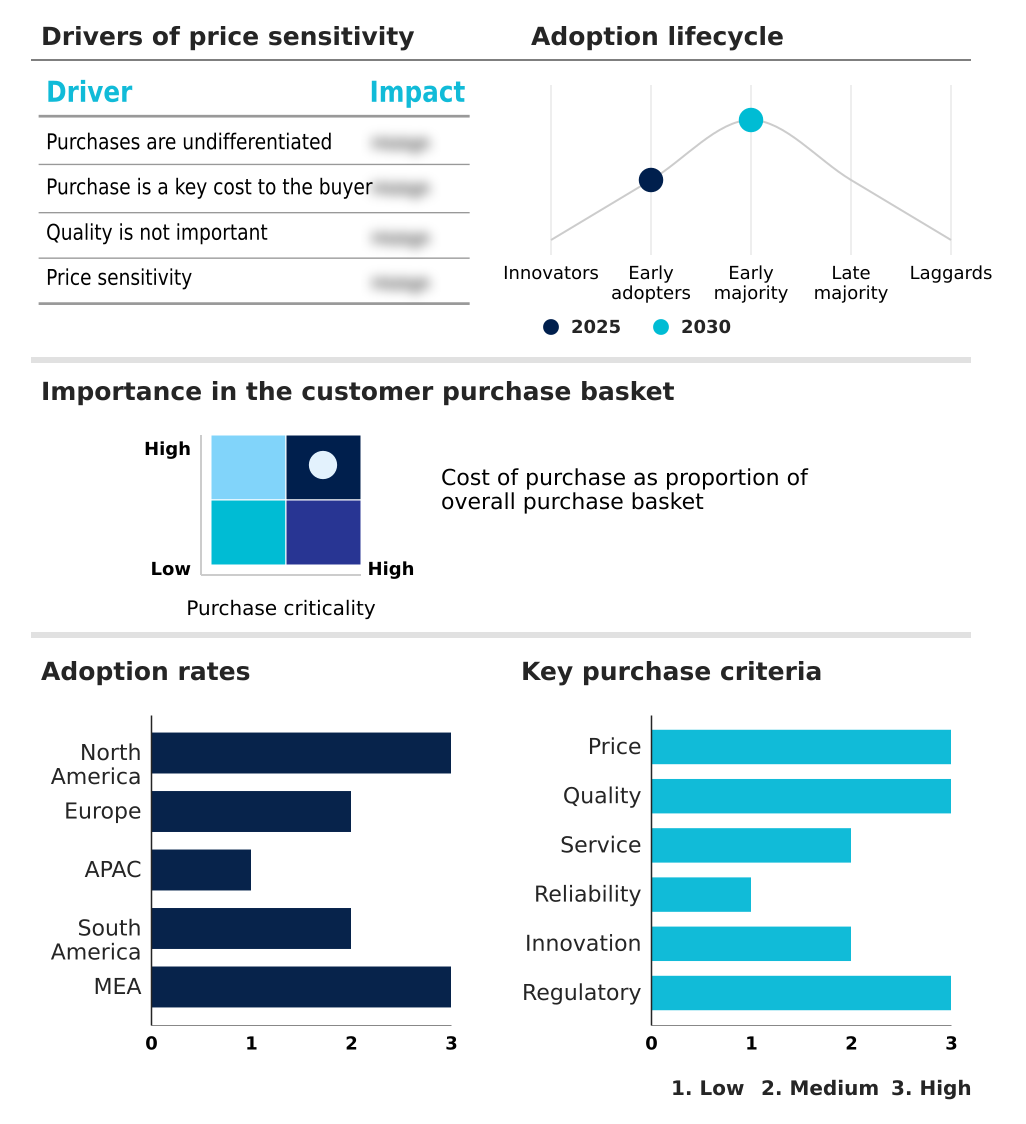
Customer Landscape of Cloud Encryption Software Industry
Competitive Landscape
Companies are implementing various strategies, such as strategic alliances, cloud encryption software market forecast, partnerships, mergers and acquisitions, geographical expansion, and product/service launches, to enhance their presence in the industry.
Akeyless Security Ltd. - Providers deliver robust cryptographic platforms featuring external key management, hardware-backed key custody, and centralized tokenization solutions that ensure stringent data privacy compliance and multicloud data protection.
The industry research and growth report includes detailed analyses of the competitive landscape of the market and information about key companies, including:
- Akeyless Security Ltd.
- Alibaba Cloud
- Amazon Web Services Inc.
- Box Inc.
- Cryptomathic
- Entrust Corp.
- Fortanix
- Google LLC
- IBM Corp.
- Microsoft Corp.
- Netskope Inc.
- Open Text Corp.
- Oracle Corp.
- PKWARE Inc.
- Protegrity USA Inc.
- Salesforce Inc.
- SAP SE
- ServiceNow Inc.
- Thales Group
- Utimaco GmbH
- Virtru Corp.
Qualitative and quantitative analysis of companies has been conducted to help clients understand the wider business environment as well as the strengths and weaknesses of key industry players. Data is qualitatively analyzed to categorize companies as pure play, category-focused, industry-focused, and diversified; it is quantitatively analyzed to categorize companies as dominant, leading, strong, tentative, and weak.
Recent Development and News in Cloud encryption software market
- In the Systems Software industry, the rapid transition toward zero-trust network architectures forced enterprises to isolate application workloads, directly impacting Cloud Encryption Software demand by requiring dedicated key lifecycle automation to secure microservices.
- Stringent data localization regulations across European jurisdictions compelled cloud infrastructure operators to deploy regional data centers, establishing a direct need for Cloud Encryption Software platforms capable of maintaining localized external key management protocols.
- The widespread integration of retrieval-augmented generation frameworks into enterprise applications created vulnerable vector data pipelines, accelerating Cloud Encryption Software adoption to protect proprietary business intelligence during model processing.
- Escalating supply chain cyberattacks targeting identity and access management registries led infrastructure developers to implement stricter hardware attestation workflows, increasing Cloud Encryption Software requirements for secure remote key release.
Dive into Technavio’s robust research methodology, blending expert interviews, extensive data synthesis, and validated models for unparalleled Cloud Encryption Software Market insights. See full methodology.
| Market Scope | |
|---|---|
| Page number | 308 |
| Base year | 2025 |
| Historic period | 2020-2024 |
| Forecast period | 2026-2030 |
| Growth momentum & CAGR | Accelerate at a CAGR of 22% |
| Market growth 2026-2030 | USD 9485.1 million |
| Market structure | Fragmented |
| YoY growth 2025-2026(%) | 21.5% |
| Key countries | US, Canada, Mexico, Germany, UK, France, Italy, Spain, The Netherlands, China, Japan, India, South Korea, Australia, Indonesia, Brazil, Argentina, Chile, Saudi Arabia, UAE, South Africa, Israel and Turkey |
| Competitive landscape | Leading Companies, Market Positioning of Companies, Competitive Strategies, and Industry Risks |
Research Analyst Overview
- Modern enterprise security architectures continually adapt to address the escalating complexity of multicloud environments and evolving threat vectors. Strategic boardroom discussions increasingly prioritize the adoption of a crypto agile architecture to ensure long-term compliance and mitigate the risks associated with legacy cryptographic deprecation.
- By directing investments toward advanced field level encryption, organizations protect sensitive transactional datasets while maintaining operational usability for analytics teams. Implementing format preserving encryption enables seamless integration with existing database schemas, driving a 35% reduction in application refactoring costs compared to traditional obfuscation methods.
- Furthermore, the deployment of transparent data encryption safeguards entire storage volumes without requiring complex application-layer modifications, expediting large-scale workload migrations. Executive leadership teams mandate the use of a secure key encapsulation mechanism and an updated digital signature algorithm to validate software integrity and prevent unauthorized modifications.
- Combining these techniques with robust envelope encryption establishes a layered defense strategy, optimizing digital asset protection and aligning technology investments directly with corporate risk management objectives.
What are the Key Data Covered in this Cloud Encryption Software Market Research and Growth Report?
-
What is the expected growth of the Cloud Encryption Software Market between 2026 and 2030?
-
USD 9.49 billion, at a CAGR of 22%
-
-
What segmentation does the market report cover?
-
The report is segmented by End-user (BFSI, Manufacturing, Professional services, Healthcare, and Others), Organization Size (Large enterprise, and SME), Component (Software, and Services) and Geography (North America, Europe, APAC, South America, Middle East and Africa)
-
-
Which regions are analyzed in the report?
-
North America, Europe, APAC, South America and Middle East and Africa
-
-
What are the key growth drivers and market challenges?
-
Increasing enforcement of data sovereignty and operational resilience regulations, Fragmented encryption key management across multicloud and hybrid environments
-
-
Who are the major players in the Cloud Encryption Software Market?
-
Akeyless Security Ltd., Alibaba Cloud, Amazon Web Services Inc., Box Inc., Cryptomathic, Entrust Corp., Fortanix, Google LLC, IBM Corp., Microsoft Corp., Netskope Inc., Open Text Corp., Oracle Corp., PKWARE Inc., Protegrity USA Inc., Salesforce Inc., SAP SE, ServiceNow Inc., Thales Group, Utimaco GmbH and Virtru Corp.
-
Market Research Insights
- Modern enterprises prioritize robust cloud infrastructure security to protect distributed data assets against sophisticated intrusion tactics. By implementing stringent data sovereignty compliance frameworks, organizations enhance cross-border operational transparency. Deploying advanced credential theft mitigation strategies allows security teams to isolate compromised identities effectively, contributing to a 34% acceleration in cyber breach containment times compared to traditional perimeter defenses.
- Furthermore, integrating centralized audit logging mechanisms improves visibility into decryption requests, yielding a 41% reduction in compliance reporting errors. These strategic adaptations empower IT leaders to standardize key lifecycle policies across multicloud environments, optimizing resource allocation and solidifying the cryptographic resilience necessary for secure digital transformation.
We can help! Our analysts can customize this cloud encryption software market research report to meet your requirements.
 RIA -