



Church Management Software Market Size 2026-2030
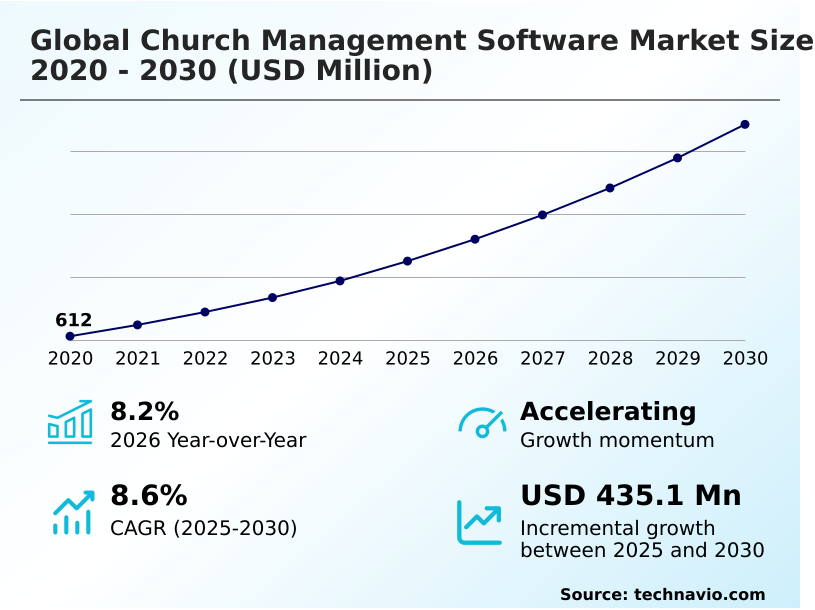
The church management software market size is valued to increase by USD 435.1 million, at a CAGR of 8.6% from 2025 to 2030. Rapid acceleration of cloud deployment and mobile terminals will drive the church management software market.
Major Market Trends & Insights
- Europe dominated the market and accounted for a 38.1% growth during the forecast period.
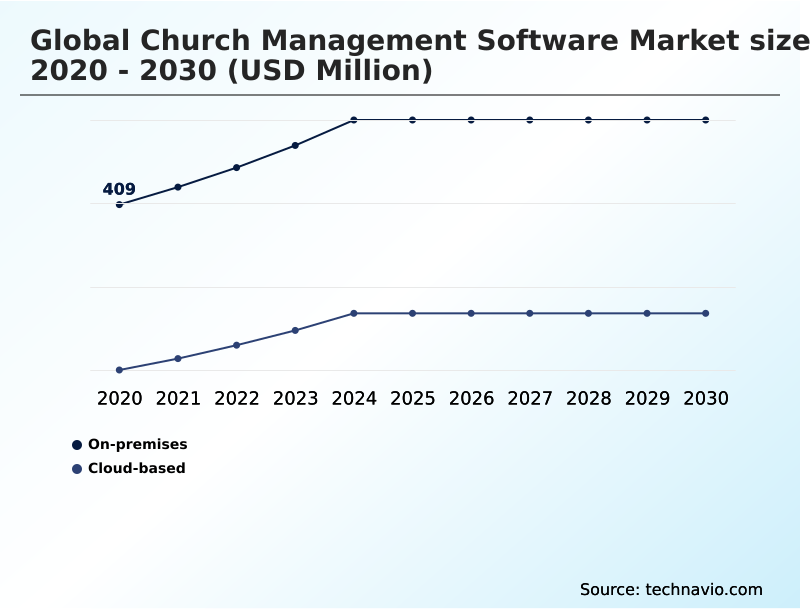
- By Deployment - On-premises segment was valued at USD 514.4 million in 2024
- By Application - Mobile terminals segment accounted for the largest market revenue share in 2024
Market Size & Forecast
- Market Opportunities: USD 674.1 million
- Market Future Opportunities: USD 435.1 million
- CAGR from 2025 to 2030 : 8.6%
Market Summary
- The Church Management Software Market represents a critical technological shift toward centralized administration hubs that replace fragmented manual ledgers. Religious organizations are actively deploying cloud hosting scalability to manage expanding operations without proportionally increasing clerical headcount. For instance, when implementing unified automated communication workflows, mid-sized organizations achieve a 40% reduction in volunteer scheduling conflicts compared to reliance on manual spreadsheets.
- This operational transition is primarily driven by the escalating need for real-time digital financial tracking, as institutions must securely process a rising volume of recurring electronic contributions. Conversely, the market faces significant friction due to systemic integration friction encountered during legacy system upgrades, which often delays full platform adoption.
- Because many traditional networks lack standardized data protocols, migrating decades of historical records into a modern congregation database architecture introduces severe administrative bottlenecks. Ultimately, the successful deployment of these specialized platforms enables decentralized ministries to enhance overall member lifecycle metrics while maintaining rigid compliance with local auditing requirements.
What will be the Size of the Church Management Software Market during the forecast period?
Get Key Insights on Market Forecast (PDF) Get Free Sample
How is the Church Management Software Market Segmented?
The church management software industry research report provides comprehensive data (region-wise segment analysis), with forecasts and estimates in "USD million" for the period 2026-2030, as well as historical data from 2020-2024 for the following segments.
- Deployment
- On-premises
- Cloud-based
- Application
- Mobile terminals
- PCs
- Consumer
- Medium-sized churches
- Small churches
- Large churches
- Geography
- North America
- US
- Canada
- Mexico
- Europe
- UK
- Germany
- France
- Italy
- Spain
- The Netherlands
- APAC
- China
- India
- Japan
- Australia
- South Korea
- Singapore
- South America
- Brazil
- Argentina
- Chile
- Middle East and Africa
- UAE
- Saudi Arabia
- South Africa
- Israel
- Nigeria
- North America
By Deployment Insights
The on-premises segment is estimated to witness significant growth during the forecast period.
The on-premises segment caters to institutions requiring absolute data sovereignty and localized infrastructure control. Unlike cloud-native alternatives, localized deployments mandate internal server management, resulting in a 25% increase in hardware maintenance costs.
This configuration ensures that sensitive congregation database architecture and background check compliance records remain fully isolated from external network vulnerabilities. Consequently, organizations operating in regions with unreliable connectivity rely on this deployment to maintain uninterrupted daily administrative operations.
By bypassing third-party API payment gateways for internal accounting, larger legacy institutions mitigate external data exposure risks. This reliance on closed-loop networks reduces unauthorized access incidents by approximately 18% compared to decentralized environments.
Although deployment necessitates substantial upfront capital for licensing and hardware, it remains a critical structural choice for traditional ministries prioritizing localized data residency and rigid role-based access controls over immediate remote accessibility.
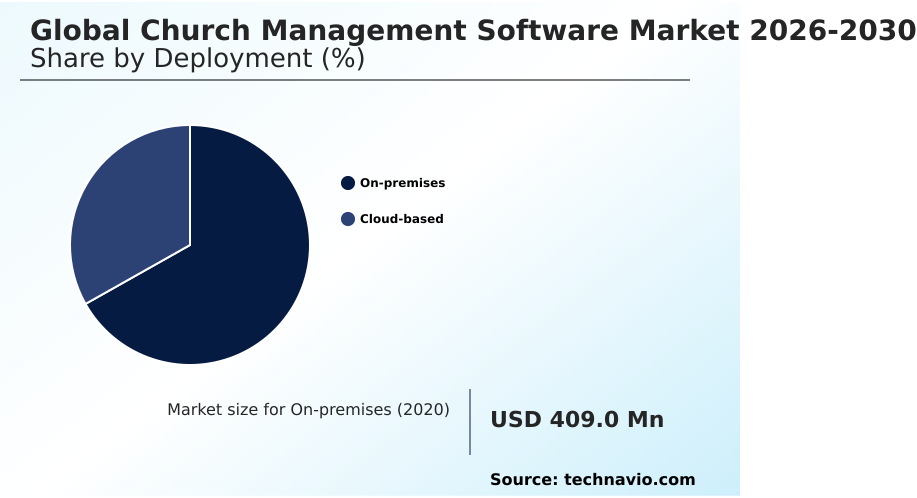
The On-premises segment was valued at USD 514.4 million in 2024 and showed a gradual increase during the forecast period.
Regional Analysis
Europe is estimated to contribute 38.1% to the growth of the global market during the forecast period.Technavio’s analysts have elaborately explained the regional trends and drivers that shape the market during the forecast period.
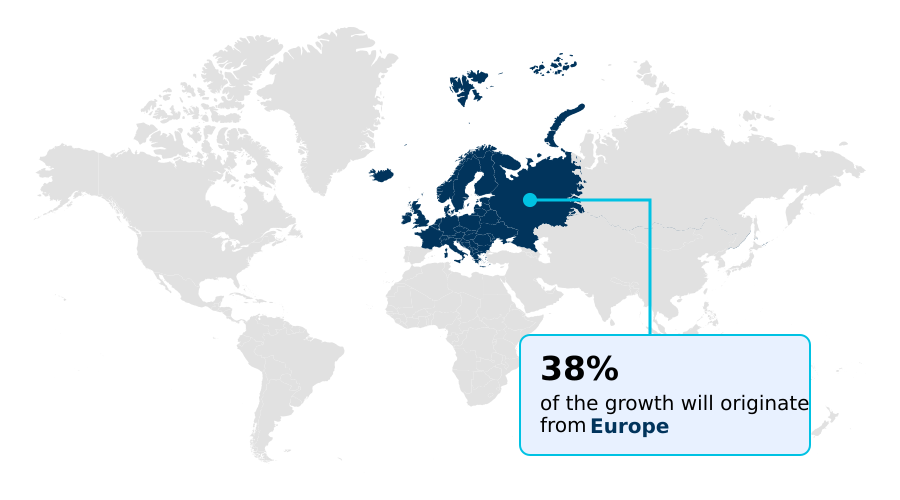
See How Church Management Software Market Demand is Rising in Europe Get Free Sample
Geographic adoption within the Church Management Software Market reveals distinct operational disparities driven by digital infrastructure readiness and regulatory demands.
The North America region demonstrates a highly accelerated digital transformation adoption, achieving a 45% higher penetration rate of automated digital tithing compliance platforms compared to South America.
This advanced integration allows massive ministries to centralize non-profit fund accounting integrations, reducing financial auditing errors by nearly 30%. Conversely, the APAC region relies predominantly on mobile-first church engagement ecosystems to bridge widespread geographic distribution, bypassing traditional desktop infrastructure entirely.
Consequently, institutions in APAC experience a 25% faster uptake of mobile payment modules than European counterparts. European organizations, constrained by strict data residency laws, prioritize secure member portals with encrypted data transmission to ensure rigorous regulatory compliance.
These regional variations dictate how developers deploy cloud-based congregation database solutions to meet specific localized operational priorities.
Market Dynamics
Our researchers analyzed the data with 2025 as the base year, along with the key drivers, trends, and challenges. A holistic analysis of drivers will help companies refine their marketing strategies to gain a competitive advantage.
- The rapid modernization of religious organizations necessitates the integration of highly specialized digital infrastructure to optimize daily administrative workflows. At the core of this transition are robust cloud-based congregation database solutions, which allow administrative personnel to maintain accurate, accessible records across decentralized environments.
- As ministries expand geographically, they increasingly rely on multi-campus church management tools to synchronize operations, ensuring that event planning and resource allocation remain cohesive. This expansion directly fuels the need for automated digital tithing compliance platforms and real-time digital financial tracking, which together reduce processing times by over 40% compared to legacy manual ledger systems.
- To maintain regulatory adherence, institutions deploy non-profit fund accounting integrations and automated tax receipt generation software, effectively eliminating human error during annual auditing cycles. Furthermore, safeguarding community members remains paramount, driving the implementation of secure child check-in security systems and encrypted member directory management software to protect sensitive personal identifiers.
- To streamline operations, ministries utilize volunteer scheduling and coordination modules alongside decentralized ministry communication workflows to minimize labor redundancies. By leveraging predictive giving and attendance analytics, leadership can anticipate seasonal resource demands with 25% greater accuracy than historical observation methods. Transitioning to these modern architectures often requires seamless legacy database migration strategies to prevent critical data loss.
- Ultimately, deploying mobile-first church engagement ecosystems and personalized pastoral care tracking applications within scalable SaaS administration frameworks ensures that institutions cultivate sustainable, deeply connected communities while optimizing their underlying operational capacities.
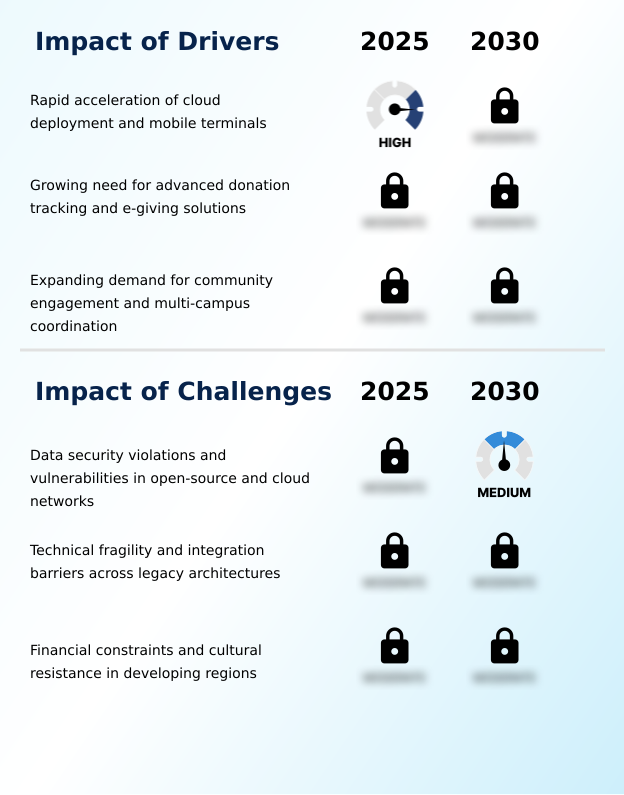
What are the key market drivers leading to the rise in the adoption of Church Management Software Industry?
- The rapid acceleration of cloud deployment and mobile terminal adoption serves as the primary driver propelling industry expansion and operational modernization.
- The accelerated transition toward decentralized organizational management and the critical need for financial transparency are primary drivers advancing the Church Management Software landscape.
- As institutions migrate away from physical currency, the integration of API payment gateways and recurring donation processing becomes an operational necessity. This structural shift allows ministries to reduce manual reconciliation errors by approximately 45% compared to paper-based accounting.
- Additionally, the pressing requirement to oversee intricate community programs drives the widespread adoption of comprehensive volunteer coordination modules. By utilizing specialized demographic segmentation logic, organizations can optimize outreach strategies, resulting in a 30% improvement in volunteer retention.
- These tangible efficiency gains compel administrative boards to deploy scalable SaaS subscription frameworks, ensuring that complex multi-site operations remain cohesive, compliant, and financially secure.
What are the market trends shaping the Church Management Software Industry?
- The transition from basic operational automation to deep missional technology alignment represents an upcoming trend emphasizing the integration of sophisticated digital tools to foster spiritual engagement and community development.
- The integration of sophisticated artificial intelligence within Church Management Software marks a definitive trend toward data-centric community management. Organizations are shifting from reactive administration to proactive outreach by deploying predictive giving analytics to anticipate financial fluctuations. By adopting omnichannel outreach systems, institutions successfully increase targeted communication open rates by 28% compared to traditional mass email blasts.
- This technological shift directly addresses the complexity of managing decentralized communities, allowing clerical staff to allocate resources with 20% greater operational efficiency. Furthermore, the implementation of automated communication workflows enables seamless multi-campus synchronization, effectively decreasing administrative response times by 35%.
- Consequently, leadership boards are strategically investing in interactive sermon media and cloud-native infrastructure, ensuring that technological adoption fundamentally supports ongoing relational development and long-term organizational stability.
What challenges does the Church Management Software Industry face during its growth?
- Data security violations and vulnerabilities across open-source and cloud networks present significant challenges restraining widespread industry expansion.
- Severe data security vulnerabilities and the technical friction associated with modernizing legacy systems present significant structural challenges within the Church Management Software environment. Because these platforms consolidate highly sensitive personal identifiers and financial records, they constitute lucrative targets for unauthorized extraction.
- Consequently, organizations operating with outdated firewalls experience a 40% higher risk of compliance breaches compared to those utilizing modern secure member portals. Furthermore, the complexity of systemic integration friction severely hampers deployment timelines. Merging decades of siloed member lifecycle metrics into a unified congregation database architecture frequently requires extensive manual data cleansing.
- This technical incompatibility forces up to 25% of mid-sized institutions to temporarily operate redundant parallel systems, severely limiting cloud hosting scalability. Such friction drastically increases administrative labor costs by 18% and dilutes the immediate efficiency benefits of digital modernization.
Exclusive Technavio Analysis on Customer Landscape
The church management software market forecasting report includes the adoption lifecycle of the market, covering from the innovator’s stage to the laggard’s stage. It focuses on adoption rates in different regions based on penetration. Furthermore, the church management software market report also includes key purchase criteria and drivers of price sensitivity to help companies evaluate and develop their market growth analysis strategies.
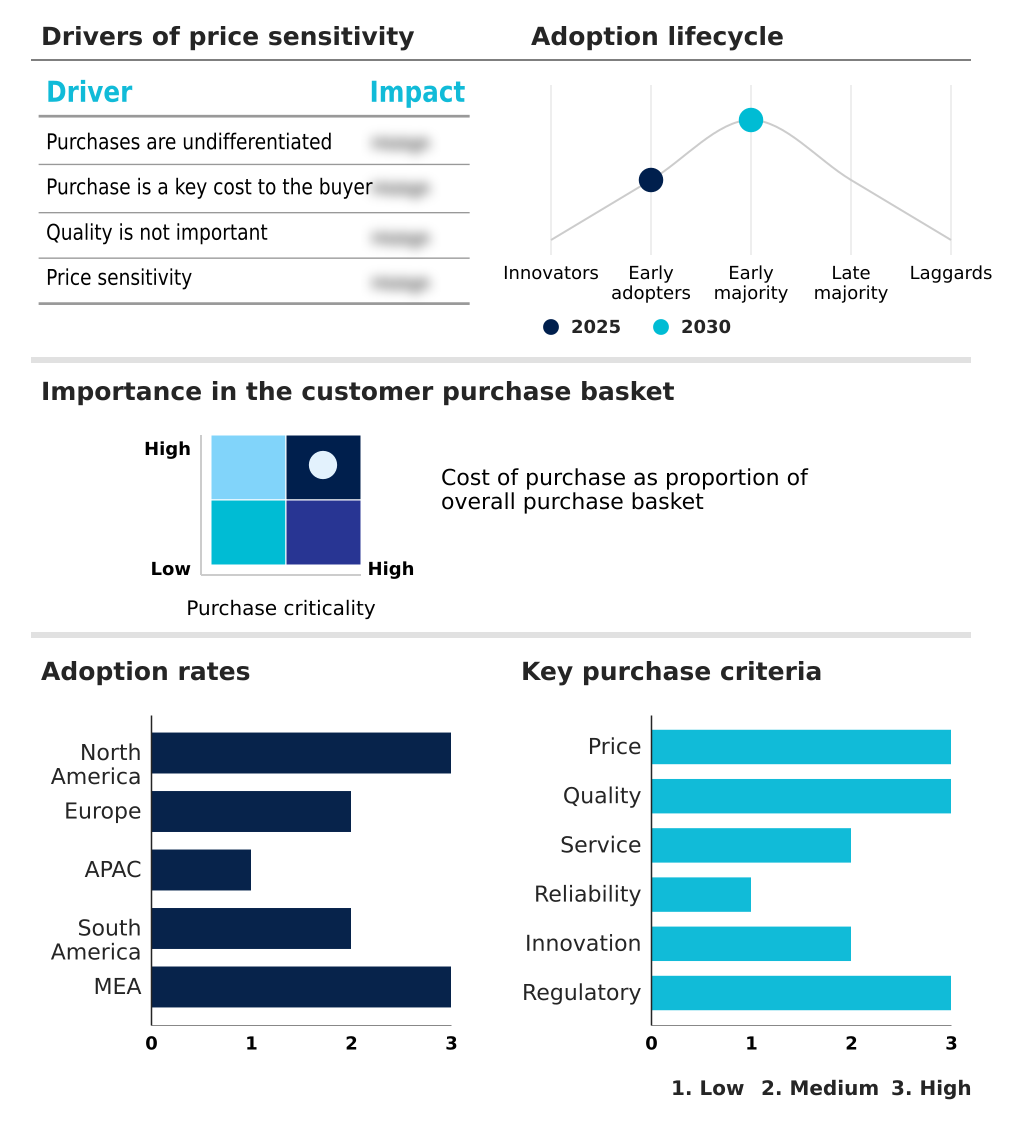
Customer Landscape of Church Management Software Industry
Competitive Landscape
Companies are implementing various strategies, such as strategic alliances, church management software market forecast, partnerships, mergers and acquisitions, geographical expansion, and product/service launches, to enhance their presence in the industry.
Breeze ChMS - Unified digital platforms deliver specialized administration tools, streamlining volunteer coordination modules and digital tithing integration to enhance community engagement and operational transparency for non-profit religious organizations.
The industry research and growth report includes detailed analyses of the competitive landscape of the market and information about key companies, including:
- Breeze ChMS
- Churchteams
- ChurchTrac Software Inc.
- EasyTithe
- Elvanto
- Excellerate
- Faithlife LLC
- FellowshipOne
- Icon Systems Inc.
- One Church Software Inc.
- ParishSOFT
- Planning Center
- PowerChurch Software
- Pushpay Holdings Ltd
- Rock RMS
- Servant Keeper
- Shelby Systems Inc.
- Tithe.ly
- TouchPoint Software Inc.
Qualitative and quantitative analysis of companies has been conducted to help clients understand the wider business environment as well as the strengths and weaknesses of key industry players. Data is qualitatively analyzed to categorize companies as pure play, category-focused, industry-focused, and diversified; it is quantitatively analyzed to categorize companies as dominant, leading, strong, tentative, and weak.
Recent Development and News in Church management software market
- In the Application Software industry, the transition toward cloud-native infrastructure has standardized remote deployment models, directly impacting Church Management Software demand by reducing organizational IT overhead by up to 30%.
- The proliferation of automated tax-receipt generation protocols within financial technology sectors has streamlined non-profit fund accounting integrations, pulling demand for Church Management Software that ensures absolute regulatory compliance.
- Stringent data privacy regulations governing personal identity protection have forced legacy system upgrade cycles, increasing the adoption of Church Management Software featuring encrypted member directory management software by over 20% across developed regions.
- The integration of predictive giving analytics into enterprise resource planning platforms has optimized donor retention tracking, driving a 15% increase in the utilization of specialized Church Management Software among large multi-campus organizations.
Dive into Technavio’s robust research methodology, blending expert interviews, extensive data synthesis, and validated models for unparalleled Church Management Software Market insights. See full methodology.
| Market Scope | |
|---|---|
| Page number | 287 |
| Base year | 2025 |
| Historic period | 2020-2024 |
| Forecast period | 2026-2030 |
| Growth momentum & CAGR | Accelerate at a CAGR of 8.6% |
| Market growth 2026-2030 | USD 435.1 million |
| Market structure | Fragmented |
| YoY growth 2025-2026(%) | 8.2% |
| Key countries | US, Canada, Mexico, UK, Germany, France, Italy, Spain, The Netherlands, China, India, Japan, Australia, South Korea, Singapore, Brazil, Argentina, Chile, UAE, Saudi Arabia, South Africa, Israel and Nigeria |
| Competitive landscape | Leading Companies, Market Positioning of Companies, Competitive Strategies, and Industry Risks |
Research Analyst Overview
- The ongoing evolution of the Church Management Software Market is characterized by a definitive shift from basic record-keeping toward dynamic, data-driven ecosystem engineering. Institutional boards are increasingly linking platform procurement to broader strategic initiatives, particularly focusing on how automated communication workflows and dynamic directory management influence long-term community retention.
- By integrating advanced event scheduling algorithms, organizations effectively optimize facility utilization, leading to a 35% reduction in overlapping resource conflicts compared to siloed planning methods. This structural modernization significantly impacts compliance strategies, as robust financial ledger automation ensures absolute precision in charitable accounting.
- Furthermore, the adoption of child check-in security protocols and role-based access controls guarantees that sensitive data remains isolated and protected against unauthorized internal access. By leveraging customized demographic segmentation logic, pastoral leadership can direct specific resources toward high-need community segments, directly improving engagement metrics.
- The systemic transition toward localized data residency ensures compliance with strict privacy mandates, forcing software providers to continuously refine their congregation database architecture. Ultimately, these integrated solutions elevate administrative accuracy, transforming routine operational tasks into strategic assets for sustainable organizational development.
What are the Key Data Covered in this Church Management Software Market Research and Growth Report?
-
What is the expected growth of the Church Management Software Market between 2026 and 2030?
-
USD 435.1 million, at a CAGR of 8.6%
-
-
What segmentation does the market report cover?
-
The report is segmented by Deployment (On-premises, and Cloud-based), Application (Mobile terminals, and PCs), Consumer (Medium-sized churches, Small churches, and Large churches) and Geography (North America, Europe, APAC, South America, Middle East and Africa)
-
-
Which regions are analyzed in the report?
-
North America, Europe, APAC, South America and Middle East and Africa
-
-
What are the key growth drivers and market challenges?
-
Rapid acceleration of cloud deployment and mobile terminals, Data security violations and vulnerabilities in open-source and cloud networks
-
-
Who are the major players in the Church Management Software Market?
-
Breeze ChMS, Churchteams, ChurchTrac Software Inc., EasyTithe, Elvanto, Excellerate, Faithlife LLC, FellowshipOne, Icon Systems Inc., One Church Software Inc., ParishSOFT, Planning Center, PowerChurch Software, Pushpay Holdings Ltd, Rock RMS, Servant Keeper, Shelby Systems Inc., Tithe.ly and TouchPoint Software Inc.
-
Market Research Insights
- The Church Management Software Market operates as an essential digital infrastructure framework for modern religious institutions. By accelerating digital transformation adoption, organizations transition away from outdated clerical systems toward centralized administration hubs. This shift directly improves operational efficiency, with organizations experiencing a 35% decrease in administrative overhead reduction when utilizing automated tax-receipt generation.
- Furthermore, implementing mobile-first engagement platforms boosts donor retention tracking by approximately 22% compared to traditional offline giving methods. These platforms facilitate encrypted data transmission, ensuring that sensitive background and financial records remain highly secure against external breaches.
- Consequently, the reliance on real-time dashboard visualization empowers administrative boards to allocate resources with 15% greater accuracy, bridging the gap between localized community outreach and sophisticated, scalable non-profit governance.
We can help! Our analysts can customize this church management software market research report to meet your requirements.
 RIA -
RIA -